Content
Aluminium MIG welding is unforgiving. The wire is soft, the oxide layer is thick, and the heat tolerance of aluminium is roughly half that of steel. A standard MIG machine that feeds 1.2 mm steel wire cleanly will often stall on 1.2 mm aluminium wire, leaving spatter, cold starts, and an uneven bead. The fix starts with the machine. A purpose-built aluminium MIG welding machine from Taizhou Miracher Machinery Co., Ltd. uses a double-pulse waveform, a synergic voltage-to-wire-speed curve, and a duty cycle that keeps production moving.
Double pulse is the single most decisive feature for aluminium MIG welding. Standard pulsed MIG lowers the current to keep the arc stable. Double pulse alternates between a hot phase and a cool phase: the weld pool wets forward in the hot phase and contracts in the cool phase. That cycle cuts average heat input, prevents burn-through on thin sheet, and produces a fine, even bead ripple.
The practical result is a visible drop in spatter. On 1.0 mm and 1.2 mm aluminium wire, a double-pulse machine runs at a lower average amperage without stalling, and many fabricators skip the grinding stage after a pass. Without double pulse, a 250 A machine is likely to burn through the edges of a 2 mm sheet while leaving lack of fusion in the root of a 6 mm joint.
Double pulse is the difference between fighting the material and guiding the weld pool.
For a broader view of MIG welding technologies, read our detailed guide to MIG welding machines.
Start from thickness, not from the largest job you hope to win. Aluminium conducts heat well, so an undersized machine produces a weld that looks fine on the first pass and collapses on the second or third. A 200 A machine covers 1.5-4 mm aluminium. A 250 A machine covers 1.5-6 mm. A 300 A to 350 A machine handles 3-10 mm, depending on joint design.
| Material thickness | Machine class | Wire diameter |
| 1.5 to 2.0 mm | 200 A | 0.8 to 1.0 mm |
| 2.0 to 4.0 mm | 250 A | 1.0 to 1.2 mm |
| 4.0 to 8.0 mm | 300 to 350 A | 1.2 mm |
For a shop that mostly welds 2 mm to 4 mm aluminium, a 250 A double-pulse machine is the sweet spot. It keeps enough current for a 3 mm plate and still welds thin sheet at lower settings. If you run 8 mm structural joints in a production cycle, a 300 A or 350 A model with dual voltage support pays for itself on the first thick weld.
Duty cycle at the rated current tells you more about real-world capability than the maximum current spec.
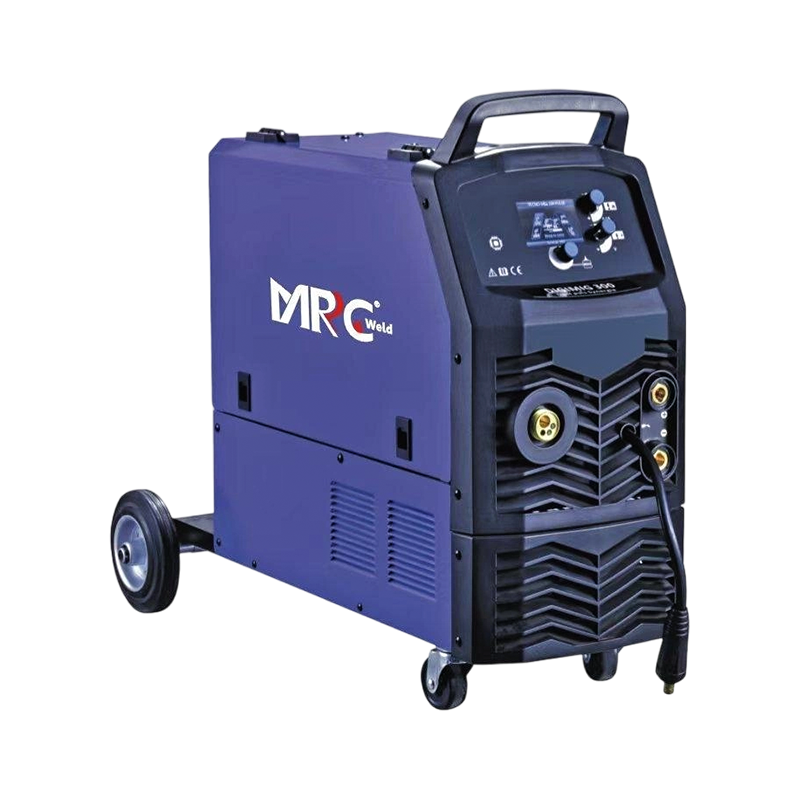 Multi-Station Dual-Voltage MIG Welding Machine with Synergic ControlThis dual-voltage MIG welder features IGBT inverter technology and dual-pulse MIG mode, providing precise welding for aluminum and thin materials. Its synergic control links wire speed to arc voltage, reducing operator error.View Product →
Synergic control links wire feed speed to arc voltage. When you increase wire speed, the machine raises voltage automatically. This removes the biggest source of operator error on aluminium: choosing the wrong voltage for the selected wire speed. A good synergic machine should let you set the wire size and weld current without hunting through a voltage chart.
Feeding is the second part. Aluminium wire is soft, and friction in the torch liner causes bird-nesting. A 5 kg spool machine with a 4-roller drive feeds aluminium more consistently than a 1 kg spool machine. Fabricators report fewer wire-feed interruptions when they move to a 5 kg spool, and every interruption can create a restart defect in the weld.
For serious aluminium work, the minimum specification is a double-pulse machine, a 5 kg spool, a 4-roller feeder, and synergic control.
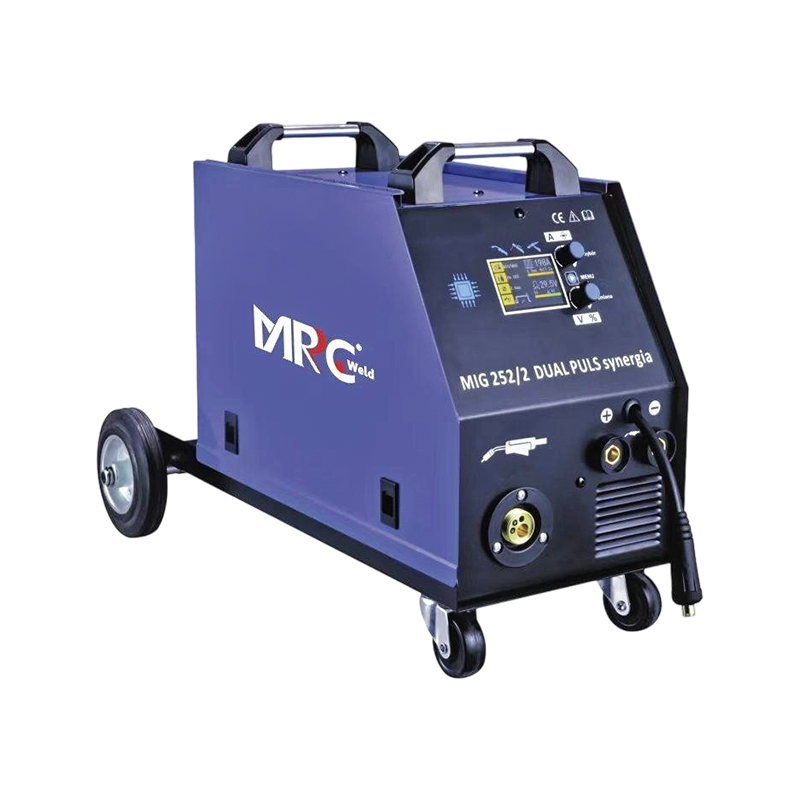 Double Pulse MIG Welding Machine with Synergic ProgramsA microprocessor-controlled multi-process welder with built-in synergy programs, adjustable pulse rate, and gas outflow time. It supports MIG/MAG, MMA, TIG lift pulse, and spot welding, making it suitable for aluminum fabrication.View Product →
The machine is only half of the equation. For aluminium, use 100% argon unless you need a helium mix for very thick sections. Pure argon produces a smooth, quiet arc with good penetration on aluminium up to about 10 mm. A standard CO2/argon mix is not suitable for aluminium and will cause porosity and heavy spatter.
Surface preparation is non-negotiable. Remove the oxide layer with a stainless steel wire brush immediately before welding, and degrease with acetone. Use a dedicated grinding disc for aluminium and never reuse one that has touched steel, because embedded steel particles create corrosion in the weld.
For 1.0 mm wire, a spool gun eliminates liner drag. A 4-roller feed machine with a low-friction liner can handle 1.2 mm wire without trouble. Keep the torch cable straight, because every coil adds tension. If you weld high-amperage aluminium continuously, a water cooling system for the torch becomes worth considering.
Test the setup on a scrap piece of the same thickness before the real job. A short 20 cm bead, cut and bent, reveals more about weld quality than any spec sheet.
When you compare machines, review these points in this order. Duty cycle and voltage compatibility are the first filters, then double pulse, then wire format and service support.
Comparing a 1 kg spool machine to a 5 kg spool machine shows the difference clearly.
If your business runs a full shift of aluminium fabrication, choose the 5 kg format. If the welder is used once a week, a 1 kg machine still works, but double pulse stays the deciding factor in both cases.
 Double Pulse Welding Machine with LED/LCD DisplayThis IGBT inverter welder offers advanced dual-pulse waveform modulation for superior arc performance. With synergic functionality and a quad-protection system, it ensures consistent welds on aluminum and other materials.View Product →
Choose double pulse first, then amperage. A 200 A double-pulse machine outwelds a 250 A standard machine on aluminium sheet.
You can, but only if the machine has a pulsed waveform or a double-pulse function. A plain constant-voltage MIG machine produces heavy spatter and poor arc control on aluminium. The heat input is difficult to manage, and you will get burn-through on thin sheet.
Double pulse alternates between a high current phase and a low current phase during welding. The high phase melts the wire and wets the pool forward, while the low phase lets the pool contract slightly. This reduces average heat input, lowers spatter, and creates a fine, even bead ripple.
Around 200 A to 250 A is enough for 3 mm aluminium in a single pass. A 250 A machine gives you headroom to run the joint without overheating the material, and the double-pulse function makes the weld more controllable.
For 1.0 mm wire, a spool gun helps because soft wire drags in the liner. For 1.2 mm wire, a good low-friction liner and a 4-roller feeder are usually enough. If you weld aluminium all day, a spool gun reduces downtime and improves consistency.
1. How Does an MMA Welding Machine Work? Explanation of the basic operation and princi...
View MoreI. Introduction Welding is a fundamental process in countless industries, joining metals ...
View MoreI. Introduction: The key guardian of car energy In the complex system of the car, the Car...
View MoreWhat is car battery charger fully Car battery charger fully is a device specially used to...
View More
Copyright © TAIZHOU MIRACHER MACHINERY CO., LTD. All Rights Reserved Custom Industrial Welding Equipment Manufacturers



 English
  Português
 sale@miracher.com
 0086-15988994409