Content
Selecting the correct TIG welding machine for industrial or batch production requires more than comparing price points. Tungsten Inert Gas (TIG) welding — formally designated as Gas Tungsten Arc Welding (GTAW) per AWS terminology — is the process of choice when weld quality, dimensional precision, and material versatility are non-negotiable requirements. This guide provides an engineering-level evaluation framework for procurement managers, wholesale distributors, and production engineers sourcing TIG equipment at volume.
TIG welding produces an arc between a non-consumable tungsten electrode and the base metal. The arc melts the base material, and filler wire is introduced manually or through an automated feed mechanism. The entire weld pool is protected from atmospheric contamination by a continuous flow of inert shielding gas. This process produces the cleanest, most controllable weld bead of any arc welding method, with no slag, minimal spatter, and a narrow heat-affected zone (HAZ).
The three consumable variables in TIG welding each affect weld quality independently. Shielding gas selection determines arc stability and oxidation protection. The following inputs are standard in professional TIG applications:
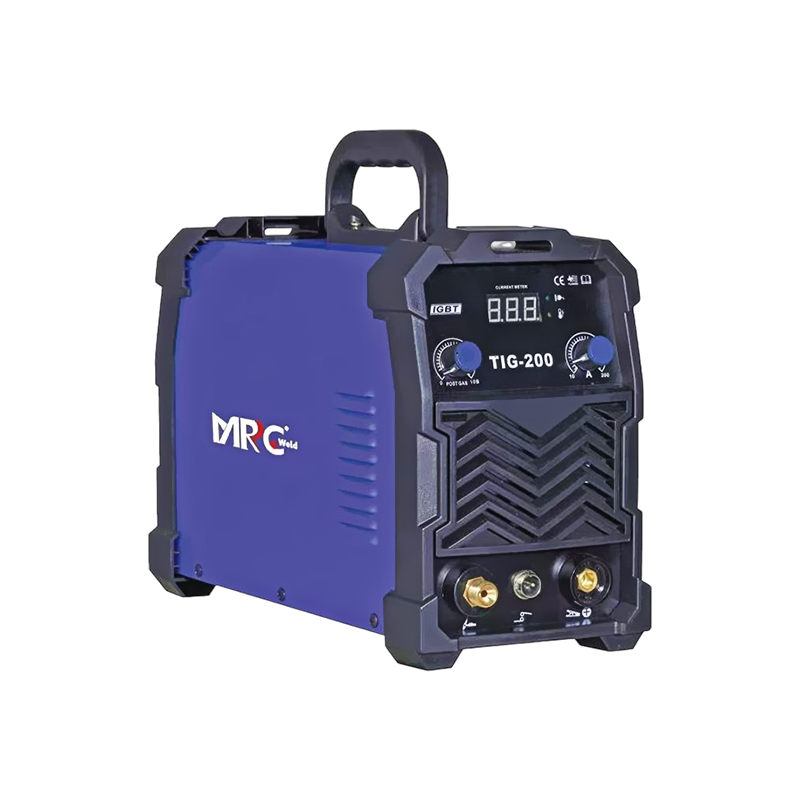
Output current type is the most fundamental specification difference between TIG welding machines. AC (alternating current) and DC (direct current) outputs produce physically different arc behaviors and are suited to different base materials. Buyers must specify output type based on their material mix before evaluating any other machine parameter. The table below compares AC and DC TIG output across the dimensions most relevant to production purchasing decisions.
| Parameter | AC TIG Output | DC TIG Output (DCEN) |
|---|---|---|
| Primary material application | Aluminum, magnesium alloys | Steel, stainless steel, titanium, copper |
| Oxide cleaning action | Yes (electrode positive half-cycle) | No |
| Electrode tip profile | Balled tip (formed during welding) | Pointed or truncated tip |
| Arc stability | Moderate (requires high-frequency start) | High |
| Heat distribution | Balanced (50/50 electrode and workpiece) | 70% workpiece / 30% electrode |
| Penetration profile | Broad, shallow | Narrow, deep |
| Typical frequency range (AC) | 20–200 Hz (inverter-based machines) | Not applicable |
Modern inverter-based machines offer both AC and DC output in a single unit, which provides maximum material flexibility. Square-wave AC with adjustable frequency and balance control has replaced conventional sine-wave AC in professional-grade equipment, allowing operators to tune oxide cleaning intensity and penetration profile independently.
A TIG welding machine for aluminum and stainless steel must offer both AC and DC output, adjustable AC frequency (typically 20–200 Hz), and AC balance control (typically 20–80% electrode positive). These controls directly affect the ratio of oxide cleaning to penetration on aluminum, and they are absent on DC-only machines.
Stainless steel welding on DC requires additional consideration of heat input management. Austenitic grades (300-series) are susceptible to sensitization — chromium carbide precipitation at grain boundaries — when heated above approximately 425 degrees Celsius for extended periods. Low heat input through controlled amperage, high travel speed, and pulse welding capability are essential machine features for stainless steel production welding.
Other materials commonly processed on TIG equipment in industrial settings include:
Amperage range and resolution determine a machine's suitability for the material thickness range in a production environment. The relationship between material thickness and recommended amperage follows an approximate rule of 1 amp per 0.025 mm (0.001 inch) of base metal thickness for steel. Aluminum requires approximately 1.5 times this value due to its higher thermal conductivity. The table below provides reference TIG welding machine amperage settings and parameters for common material and thickness combinations.
| Material | Thickness (mm) | Recommended Amperage (A) | Tungsten Diameter (mm) | Filler Wire Diameter (mm) |
|---|---|---|---|---|
| Mild steel | 1.0 | 40–60 | 1.6 | 1.6 |
| Mild steel | 3.0 | 100–130 | 2.4 | 2.4 |
| Stainless steel (304) | 2.0 | 70–90 | 2.4 | 2.0 |
| Aluminum (6061) | 2.0 | 80–110 (AC) | 2.4 | 2.4 |
| Aluminum (6061) | 4.0 | 150–180 (AC) | 3.2 | 3.2 |
| Titanium (Grade 2) | 1.5 | 50–70 (DC) | 1.6 | 1.6 |
The TIG welding machine duty cycle and power consumption specification is the most critical parameter for production environment selection. Duty cycle is expressed as a percentage of a 10-minute period during which the machine can operate at a stated amperage without exceeding its thermal limits. A machine rated at 200 A at 60% duty cycle can weld continuously for 6 minutes per 10-minute cycle at that output level.
For continuous or near-continuous production welding, buyers should target machines with duty cycle ratings of 60% or higher at the intended operating amperage. Key power parameters to verify include:
For buyers evaluating TIG welding machine wholesale price and MOQ, market segmentation by machine class is the most useful framework. Entry-level DC-only inverter machines (up to 200 A) occupy the lowest price tier and are suited to light fabrication and repair workshops. Mid-range AC/DC inverter machines (200–300 A) with pulse and programmable waveform control represent the most commercially active wholesale segment. Industrial-grade water-cooled systems above 350 A serve specialty manufacturing and are typically custom-quoted.
Wholesale buyers should establish the following minimum documentation requirements before issuing a purchase order:
A robust supplier qualification process for a TIG welding machine procurement program should include the following verification steps:
A TIG welding machine uses a non-consumable tungsten electrode and requires the operator to feed filler wire manually, producing a very clean and precise weld with no spatter. A MIG machine uses a continuously fed consumable wire electrode and is faster but produces a wider HAZ and requires post-weld cleaning in quality-critical applications. TIG is preferred for thin materials, precision joints, and reactive metals. MIG is preferred for higher deposition rates and thicker structural welds.
Yes, but only if the machine offers both AC and DC output modes. Aluminum requires AC output with adjustable frequency and balance control for oxide layer removal. Stainless steel is welded on DC electrode negative (DCEN). A single AC/DC inverter machine handles both materials. DC-only machines cannot weld aluminum with the TIG process and should not be marketed as general-purpose units.
Production welding environments typically require a duty cycle of 60% or higher at the intended operating amperage. A machine rated at 40% duty cycle at maximum amperage may be sufficient if actual operating amperage is significantly lower — duty cycle improves as amperage decreases. Buyers should calculate expected arc-on time per cycle based on actual production sequences and select a machine whose rated duty cycle exceeds that figure at the planned operating amperage.
For most international markets, the minimum certification set includes IEC 60974-1 for performance and safety, IEC 60974-10 for electromagnetic compatibility, and CE marking for European Union market entry. For the North American market, CSA or UL listing under relevant standards is required. Some markets additionally require local certifications such as CCC (China), EAC (Russia and Eurasian Economic Union), or BIS (India). Buyers should verify target market requirements before placing wholesale orders and request copies of all applicable certificates from suppliers.
1. How Does an MMA Welding Machine Work? Explanation of the basic operation and princi...
View MoreI. Introduction Welding is a fundamental process in countless industries, joining metals ...
View MoreI. Introduction: The key guardian of car energy In the complex system of the car, the Car...
View MoreWhat is car battery charger fully Car battery charger fully is a device specially used to...
View More
Copyright © TAIZHOU MIRACHER MACHINERY CO., LTD. All Rights Reserved Custom Industrial Welding Equipment Manufacturers



 English
  Português
 sale@miracher.com
 0086-15988994409