Content
Selecting the correct MMA welding machine requires a technical understanding of inverter technology, duty cycle limitations, and arc dynamics. For procurement specialists and industrial buyers, the decision impacts fabrication quality, operational efficiency, and total cost of ownership. This guide provides an engineer-level analysis of MMA welding technology to support informed wholesale purchasing decisions.
The duty cycle is the most critical performance specification for continuous production environments. Understanding mma welding machine duty cycle explained in technical terms prevents operational downtime and equipment failure.
Duty cycle is defined as the number of minutes out of a 10-minute period a welding machine can operate at its rated output before exceeding thermal limits. A machine rated at 200 amps with a 60% duty cycle can weld continuously for 6 minutes and must cool for 4 minutes. This testing follows international standards such as IEC 60974-1.
Different industrial applications demand different duty cycle specifications. Production environments require higher duty cycles to maintain workflow efficiency.
| Application Category | Typical Duty Cycle Requirement | Operational Impact | Machine Class Recommendation |
|---|---|---|---|
| Light home workshop | 20-30% at rated current | Intermittent use, frequent cooling breaks | Entry-level inverter |
| Light fabrication / repair | 40-60% at rated current | Balanced work-rest cycles | Mid-range industrial |
| Heavy industrial production | 80-100% at rated current | Continuous operation, minimal downtime | Heavy-duty industrial |
| Automated welding systems | 100% at rated current | 24/7 production capability | Robotic-grade power source |
Duty cycle ratings are established at 40°C ambient temperature according to international standards. Operation in higher ambient temperatures reduces the effective duty cycle proportionally. For every 10°C above 40°C, the duty cycle decreases by approximately 15-20%. Facilities in tropical climates or non-air-conditioned workshops must apply derating factors to their equipment selection .
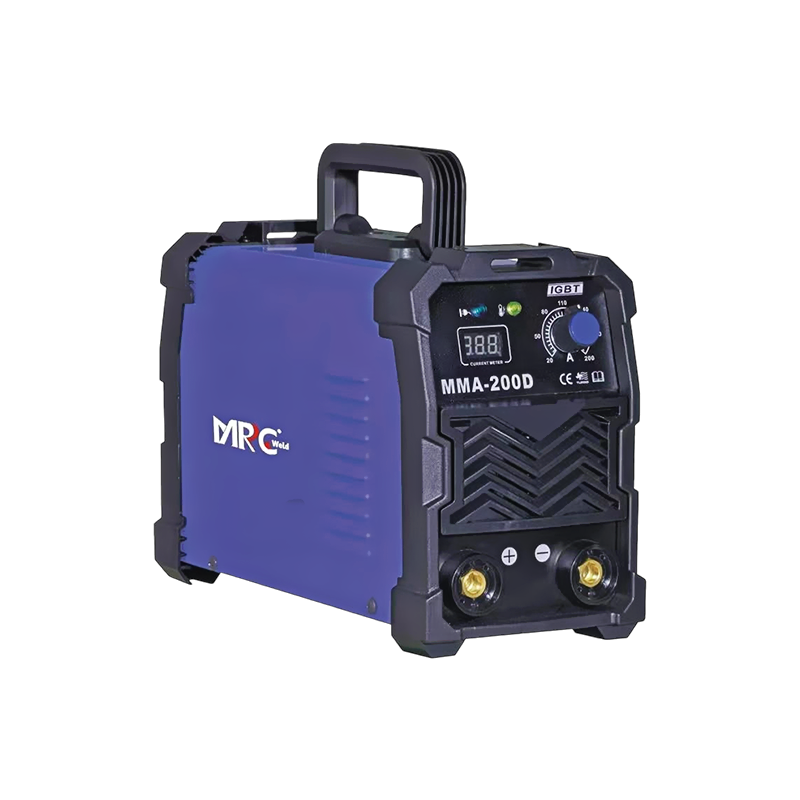
The home workshop presents unique requirements including limited electrical infrastructure, space constraints, and diverse project types. Selecting the best mma welding machine for home use requires balancing capability with practical residential limitations.
Residential garages typically provide 110V or 220V single-phase power. A 110V machine offers convenience but limits maximum output to approximately 140-160 amps, sufficient for materials up to 5mm thickness. 220V machines provide full 200-250 amp capability for thicker materials but may require electrician installation of dedicated circuits .
Home users benefit from specific technological features that compensate for varying skill levels and inconsistent material preparation.
Home workshop machines benefit from inverter technology, reducing weight from traditional transformer machines (30-40 kg) to modern inverter units (5-15 kg). Weight below 10 kg with integrated carrying handles enables single-person mobility around the property .
The decision between mma welding machine vs mig vs tig involves fundamental process physics, operator skill requirements, and application suitability. Each technology serves distinct market segments with specific performance characteristics.
| Parameter | MMA (Stick) | MIG/GMAW | TIG/GTAW |
|---|---|---|---|
| Equipment cost (inverter class) | Lowest ($200-800) | Moderate ($800-2500) | Highest ($1500-5000+) |
| Consumable cost per meter | Low | Low-moderate | High (gas, tungsten, filler) |
| Operator skill requirement | Moderate | Low (easy to learn) | Very high |
| Material thickness range | 2mm to unlimited | 0.8mm to 12mm | 0.3mm to 6mm (typical) |
| Material compatibility | Steel, stainless, cast iron | Steel, stainless, aluminum | All metals including exotics |
| Outdoor/wind suitability | Excellent (no gas) | Poor (gas dependent) | Poor (gas dependent) |
| Weld appearance | Moderate, slag removal needed | Good, minimal cleanup | Excellent, no spatter |
| Deposition rate | 1-3 kg/hour | 3-8 kg/hour | 0.5-2 kg/hour |
For construction sites and outdoor fabrication, MMA remains the preferred technology due to its wind resistance and simplicity. MIG dominates production environments requiring high deposition rates. TIG serves specialized applications demanding precision and aesthetic quality .
Arc force is a dynamic inverter response that significantly influences weld bead profile and penetration. Professional welders must understand mma welding machine arc force setting to optimize performance across different electrodes and joint configurations.
Arc force modifies the inverter's output characteristic during short-circuit events. When the electrode contacts the weld pool, voltage drops rapidly. The arc force control increases current output to clear the short circuit by vaporizing the contact point. Higher settings provide more aggressive short-circuit clearing, suitable for deep penetration and out-of-position welding .
These two parameters serve distinct purposes in the welding arc, though they are often confused by operators.
| Parameter | Timing of Effect | Function | Typical Setting Range |
|---|---|---|---|
| Hot Start | First 0.1-0.5 seconds of arc initiation | Prevents electrode sticking, ensures immediate arc establishment | 10-30% above set current |
| Arc Force | Throughout welding, during short circuits | Controls droplet detachment, maintains arc length, adjusts penetration | 0-10 (digital scale) or 10-30% boost |
Different electrode classifications require specific arc force responses for optimal performance.
Global manufacturing and international projects demand equipment flexibility. A 220v mma welding machine with dual voltage capability addresses the varying electrical standards encountered across different markets and job sites.
Industrial power systems vary significantly by region. North America commonly uses 110V for light applications and 208-240V single-phase or 480V three-phase for industrial equipment. Europe, Asia, and the Middle East predominantly utilize 220-240V single-phase and 380-415V three-phase systems. Dual voltage machines automatically adapt to these variations without manual reconfiguration .
| Feature | Automatic Dual Voltage | Manual Switch Dual Voltage | Single Voltage Machine |
|---|---|---|---|
| Input voltage range | 90-265V AC (wide) | 110V or 220V selected | Fixed (110V or 220V) |
| Operator intervention | None, plug and play | Manual switch position | None, but limited use |
| Risk of incorrect connection | Zero (auto-detection) | Moderate (operator error) | High (wrong voltage damages) |
| Typical power range | Up to 200A | Up to 250A | Varies by design |
| Export suitability | Excellent | Good | Poor (region-specific) |
Contractors working across international borders benefit from single-machine flexibility. Rental fleets can deploy equipment anywhere without maintaining separate inventories for different voltage regions. Manufacturing facilities with mixed voltage supplies can standardize on one machine type for all maintenance departments .
TAIZHOU MIRACHER MACHINERY CO., LTD. operates as a specialized foreign trade enterprise focused on welding equipment research, development, production, and export. The company is strategically located in Taizhou, Zhejiang, a major manufacturing center in China. Since establishment, the organization has committed to providing global customers with cost-effective industrial welding machines, comprehensive welding solutions, and professional support services.
The product portfolio encompasses three major fields: welding machines, air compressors, and industrial heaters. These products serve diverse applications including automobile manufacturing, metal processing, construction engineering, energy equipment fabrication, and industrial production lines.
As a practitioner of industry technological innovation, the company maintains a team of senior engineers supported by intelligent production equipment and precision inspection systems. Every manufactured unit passes strict quality management system certification. The diverse product line includes manual arc welding machines, MIG/MMA welding machines, TIG welding machines, plasma cutting machines, and automated welding equipment.
The organization functions as Custom IGBT Inverter Air Plasma Cutter Suppliers and China IGBT Inverter Air Plasma Cutter Factory. All equipment can be adapted according to customer requirements including voltage adaptation, functional module additions or deletions, and compliance with different market standards.
Adhering to the concept of "quality-driven efficiency," the company provides both standardized products and customized solutions. A full life cycle service system covers pre-sales consultation, installation and debugging, and after-sales maintenance. With excellent product performance and comprehensive customer support, the company has established long-term cooperation with hundreds of industrial enterprises globally. Products are exported to Southeast Asia, the Middle East, and European markets.
The corporate mission emphasizes "intelligent manufacturing quality, serving the world," driving continued innovation in mechanical and electrical equipment to support sustainable industry development alongside global partners.
IGBT (Insulated Gate Bipolar Transistor) technology provides higher current handling capability and better thermal performance for industrial applications above 200 amps. MOSFET (Metal-Oxide-Semiconductor Field-Effect Transistor) technology offers faster switching speeds and is typically found in lower-amperage portable machines. IGBT is preferred for heavy industrial use due to its robustness under high thermal stress .
A general engineering formula for mild steel electrodes is 30-40 amps per millimeter of electrode diameter. For a 3.2mm electrode, starting current should be 95-130 amps. This varies by electrode classification: cellulosic electrodes require 10-15% higher current than rutile types for equivalent penetration. Position welding typically requires 10-20% reduction from flat position settings .
Wholesale minimum order quantities typically range from 10-20 units for standard inverter models to 50-100 units for container shipments. Mixed containers combining welding machines, plasma cutters, and accessories can achieve better economies of scale. Customized machines with specific voltage configurations or branding may require higher minimums of 50-100 units per specification .
Altitude above 1000 meters reduces air density and cooling efficiency. Inverter cooling systems lose approximately 3-5% of their cooling capacity per 500 meters above sea level. Machines operating at 3000 meters altitude should be derated by 15-20% of rated output to prevent thermal overload. Some manufacturers offer altitude-compensated designs for high-altitude markets .
Critical certifications include CE (European Conformity) for European markets, UL or CSA for North America, and CCC (China Compulsory Certification) for Chinese domestic sales. ISO 9001:2015 quality management certification indicates consistent manufacturing processes. Additional certifications for specific applications include marine classification society approvals (ABS, DNV, Lloyds) for shipbuilding applications .
1. How Does an MMA Welding Machine Work? Explanation of the basic operation and princi...
View MoreI. Introduction Welding is a fundamental process in countless industries, joining metals ...
View MoreI. Introduction: The key guardian of car energy In the complex system of the car, the Car...
View MoreWhat is car battery charger fully Car battery charger fully is a device specially used to...
View More
Copyright © TAIZHOU MIRACHER MACHINERY CO., LTD. All Rights Reserved Custom Industrial Welding Equipment Manufacturers



 English
  Português
 sale@miracher.com
 0086-15988994409