Content
In the intricate world of metal fabrication, achieving a pristine, high-integrity weld requires not only skill but also the precision of advanced equipment. Among the various welding technologies available, Tungsten Inert Gas (TIG) welding stands out for its ability to produce clean, spatter-free, and aesthetically superior welds. At the heart of this process lies the TIG welding machine, a sophisticated device designed to deliver precise control over the heat input and arc stability. Unlike other processes that use a consumable electrode, TIG welding employs a non-consumable tungsten electrode to generate the arc. This method is particularly favored for critical applications where the appearance and structural integrity of the weld are paramount. Whether for aerospace components, artistic sculptures, or pipeline construction, the versatility of a modern TIG system allows welders to join a wide variety of metals with exceptional accuracy. As technology has evolved, these machines have become more accessible and user-friendly, incorporating inverter technology that reduces weight while increasing power efficiency. Understanding the nuances of selecting the right unit—whether it involves power output, portability, or advanced pulsing features—is essential for professionals and hobbyists alike. This guide delves into the specific capabilities of different TIG configurations, helping you navigate the technical specifications to find the perfect tool for your workshop.
When evaluating welding equipment for industrial or heavy-duty fabrication, the amperage capacity is a primary determinant of performance. A 200A TIG welding machine represents a sweet spot for many professionals, offering the power necessary to penetrate thick materials while retaining the finesse required for thinner gauge work. This specific amperage rating is critical because it dictates the machine's duty cycle and the range of material thicknesses it can effectively handle. In a production environment, a 200-amp output ensures that the welder can maintain a stable arc even when demanding high heat input for metals like stainless steel or aluminum thicker than 3/16 of an inch. Furthermore, machines in this category often come equipped with robust cooling systems and advanced circuitry that prevent overheating during prolonged use. The adaptability of a 200-amp unit makes it an excellent investment for fabrication shops that deal with a diverse project mix, from automotive restoration to structural repairs. By choosing a machine with this capacity, operators ensure they have the headroom needed to tackle challenging jobs without being limited by their equipment.
| Amperage Range | Material Thickness Capacity |
| 5A - 50A | Sensitive gauge metals (24 gauge sheet metal) |
| 50A - 100A | Light structural work (1/8 inch steel) |
| 100A - 200A | Heavy plate welding (up to 1/4 inch and thicker) |
| 200A+ | Industrial production and heavy pipe fabrication |
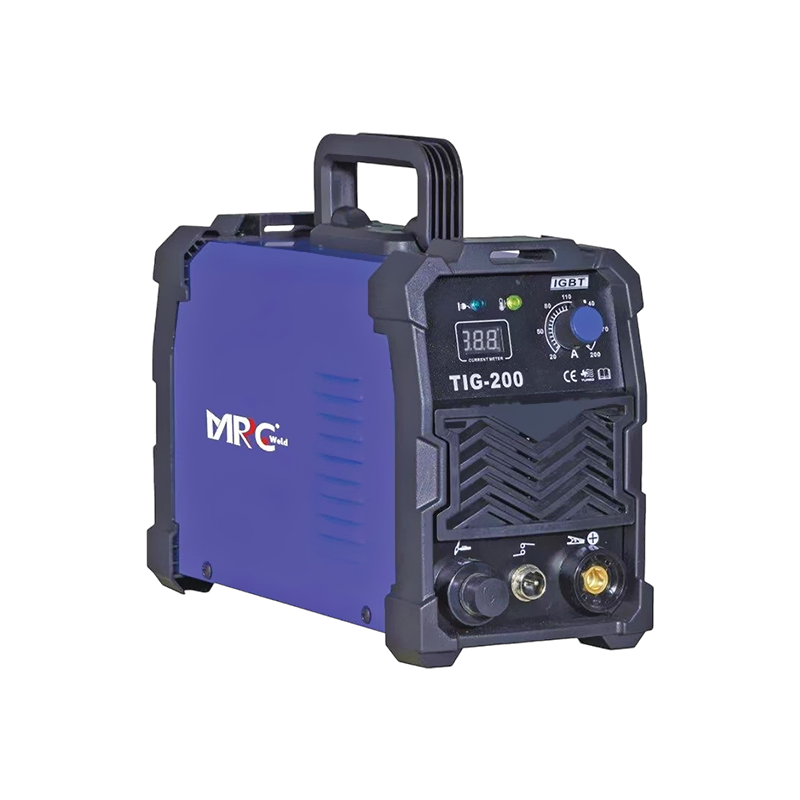
For the modern fabricator, working with a diverse array of metals is the norm rather than the exception. An AC DC TIG welding machine is the ultimate solution for workshops that demand flexibility across different material properties. The dual functionality of alternating current (AC) and direct current (DC) is what sets these machines apart. DC welding, specifically DCEN (Direct Current Electrode Negative), is the standard for welding steels, stainless steels, and copper alloys, providing a smooth, stable arc and deep penetration. However, when the job involves aluminum or magnesium, the oxide layer on the metal surface poses a challenge. This is where the AC function becomes indispensable. The alternating current cleans the oxide layer during the positive half of the cycle and melts the base metal during the negative half. Advanced machines now offer adjustable AC balance and frequency controls, allowing the welder to fine-tune the cleaning action versus the penetration width. This technological capability ensures that whether you are repairing a cast aluminum engine block or fabricating a stainless steel exhaust system, a single machine can handle the task with professional-grade results.
| Welding Mode | Best Suited Materials |
| DCEN (DC Straight) | Mild Steel, Stainless Steel, Copper, Titanium |
| DCEP (DC Reverse) | Stick welding and limited applications requiring deeper cleaning |
| AC (Alternating Current) | Aluminum, Magnesium, and aluminum alloys |
Mobility in the welding industry is a game-changer, particularly for field welders, on-site repair technicians, and hobbyists with limited shop space. The evolution of inverter technology has revolutionized the market, making the portable TIG welding machine a powerful alternative to heavy, transformer-based units. Inverters work by converting input power to a high-frequency DC, then stepping it down through a transformer, which drastically reduces the size and weight of the internal components. This means that a machine capable of welding 1/4 inch steel can now weigh less than 20 pounds and be easily carried with a shoulder strap. The portability factor does not come at the cost of performance; modern inverters offer extremely stable arc characteristics and excellent energy efficiency, often running on standard 115V or 230V household currents. This portability allows professionals to easily transport the unit to job sites, whether it is a construction site for architectural railing installation or a remote location for agricultural equipment repair. For the home user, a portable unit can be stored away when not in use, freeing up valuable garage space while still providing the power needed for serious fabrication tasks.
| Feature | Traditional Transformer | Portable Inverter |
| Weight | Heavy (80-150 lbs) | Light (10-40 lbs) |
| Footprint | Large, stationary | Compact, fits in cases |
| Efficiency | Moderate | High |
| Mobility | Requires cart or dolly | Carried by hand or shoulder strap |
For those who pursue the highest level of weld quality and control, particularly on thin materials or in out-of-position applications, a pulse TIG welding machine is an indispensable tool. Pulsing involves switching the welding current between a peak current (which melts the metal) and a background current (which maintains the arc but allows the weld pool to cool slightly). This rapid cycling offers several distinct advantages. Firstly, it drastically reduces the total heat input into the workpiece. Lower heat input minimizes the risk of warping or distorting thin sheet metal, which is a common issue in automotive and aerospace applications. Secondly, the pulsing action creates a rhythmic solidification of the weld pool, which helps the operator control the puddle more effectively, especially when welding in vertical or overhead positions. The visual effect of a correctly pulsed weld is often described as a "stack of dimes," characterized by perfectly uniform ripples that are not only aesthetically pleasing but also structurally sound. Advanced pulse parameters allow the user to adjust pulses per second and peak/background time ratios, enabling customization for specific alloys and thicknesses. This level of precision is what separates a standard weld from a true work of art, making pulse TIG the preferred choice for high-end custom fabrication.
| Pulse Parameter | Effect on Weld |
| Pulse Frequency (Hz) | Higher frequencies create a tighter, more focused arc cone |
| Peak Current | Controls the penetration depth and fluidity of the puddle |
| Background Current | Maintains the arc while cooling the weld pool to prevent burn-through |
| Pulse Width (%) | Adjusts the ratio of time spent at peak vs. background current |
Investing in a welding machine is a significant decision that requires careful consideration of your specific operational needs and future goals. With the market saturated by various models boasting different specifications, it is essential to cut through the noise and focus on the features that matter most to your workflow. The primary considerations should revolve around the types of materials you intend to weld, the thickness of those materials, and the environment in which you will be working. For instance, if your focus is exclusively on stainless steel for artistic projects, a DC-only machine might suffice. However, a fabrication shop looking to expand into automotive repair will almost certainly require the AC capabilities found in an AC DC unit. Additionally, the physical interface of the machine plays a role in productivity. User-friendly control panels with clear digital displays and ergonomic torches can reduce operator fatigue significantly. It is also wise to consider the availability of spare parts and the build quality of the unit. A robustly built machine with high-quality internal components will offer a longer service life and better resale value. By balancing the initial cost against the machine's capabilities and durability, you can ensure a purchase that enhances your welding capabilities for years to come.
| Selection Factor | Recommendation |
| Beginner/Hobbyist | DC Inverter, 160A-200A, simple interface |
| Professional Fabricator | AC/DC Inverter, 200A-250A, pulse features, water-cooler ready |
| Field Mechanic | Portable TIG welding machine, lightweight, generator compatible |
| Pipe Welder | Pulse TIG welding machine, high frequency start, remote foot control |
The primary difference lies in the electrode and the process. TIG (Tungsten Inert Gas) uses a non-consumable tungsten electrode and requires the welder to manually feed the filler rod with one hand while holding the torch with the other. This offers superior precision and control. MIG (Metal Inert Gas) uses a consumable wire electrode that is fed automatically through the gun. MIG is generally faster and easier to learn, making it better for high-production environments, whereas TIG is preferred for finer, more detailed work on thinner materials.
While many automotive body repairs involve thinner sheet metal (18-22 gauge) that can be welded with lower amperages (like a 160A unit), a 200A TIG welding machine provides greater versatility. It allows you to handle thicker components such as chassis brackets, roll cages, or engine blocks without overheating the machine. If you plan on doing a mix of bodywork and structural fabrication, the extra headroom of a 200A unit is a valuable asset.
No, welding aluminum requires an AC DC TIG welding machine. The Alternating Current (AC) function is necessary to remove the stubborn aluminum oxide layer from the surface of the metal. While there are specialized helium-based processes that allow limited aluminum welding with DC, they are not practical for general use. Therefore, to effectively weld aluminum, you must have a machine capable of producing an AC output.
A portable TIG welding machine is ideal for mobility and convenience. If you frequently work on-site at construction locations, need to move the machine around a large shop, or have limited storage space, the lightweight inverter design is superior. Modern portables now offer performance comparable to larger stationary units, meaning you do not sacrifice welding quality for the sake of size and weight.
The pulse function is most beneficial when welding thin materials or when working out of position (vertical or overhead). By pulsing the current, you reduce the overall heat input, which prevents burn-through on thin sheets like exhaust tubing or body panels. It also helps stabilize the weld pool against gravity, making it easier to create consistent, high-quality beads in difficult positions.
1. How Does an MMA Welding Machine Work? Explanation of the basic operation and princi...
View MoreI. Introduction Welding is a fundamental process in countless industries, joining metals ...
View MoreI. Introduction: The key guardian of car energy In the complex system of the car, the Car...
View MoreWhat is car battery charger fully Car battery charger fully is a device specially used to...
View More
Copyright © TAIZHOU MIRACHER MACHINERY CO., LTD. All Rights Reserved Custom Industrial Welding Equipment Manufacturers



 English
  Português
 sale@miracher.com
 0086-15988994409