Content
A 200 A inverter welding machine that weighs 5 kg will lay the same bead as a 28 kg tapped-transformer unit standing beside it on the same bench. That gap is not marketing: inverter power sources switch the mains tens of thousands of times per second, which shrinks the transformer core and the copper wound around it by roughly two orders of magnitude.
TAIZHOU MIRACHER MACHINERY CO., LTD. (MIRACHER), a welding equipment manufacturer based in Taizhou, Zhejiang, has built its MMA, MIG/MAG, TIG and plasma cutter welding equipment range around that topology since 2017. The company exports to Southeast Asia, the Middle East and Europe and reports annual export volume between USD 1.01 million and USD 5 million across a 51 to 200 person workforce. What follows is what actually separates one inverter from another on a data plate, and where buyers most often misread the numbers.
An inverter welder converts AC to DC first, switches it at high frequency, transforms it, then rectifies it again, which puts arc voltage and current under direct electronic control instead of under the fixed turns ratio of a tapped transformer. That four-stage path is the whole story, and every practical difference between a 4 kg inverter and a 30 kg transformer unit follows from it.
The signal chain runs in a fixed order on every IGBT machine, from 120 A portable units up to 350 A synergic MIG welders:
Because the control board owns the output curve, features that once needed extra hardware now live in firmware: hot start, arc force, anti-stick, and on MIG/MAG units, synergic wire feed that tracks voltage as the operator turns a single dial.
An IGBT inverter converts roughly 85% to 90% of the power it draws into arc power, while a tapped-transformer unit of the same output converts 50% to 65%, and the difference lands directly on the site's circuit breaker. That is the number that decides whether a machine runs cleanly on a 230 V supply or trips a breaker halfway through a root pass.
Work the arithmetic once and it stays useful. A 200 A weld at 24 V arc voltage is about 4.8 kW of arc power. At 86% efficiency the inverter draws roughly 5.6 kW from the mains, which at 230 V is about 24 A. A transformer unit at 58% efficiency draws around 8.3 kW, or 36 A, on exactly the same job. Same bead, half again the current.
Two details catch buyers out. First, inrush current on start-up can reach several times the running figure, so a circuit that is marginal on paper will nuisance-trip on a cold morning. Second, dual-voltage models that accept both 230 V and 400 V deliver their full amperage only on the higher supply; on 230 V the top of the range is usually derated. Always confirm which voltage the printed duty cycle refers to.
Duty cycle on an IEC 60974-1 plate is measured over a 10-minute period at an ambient of 40 °C, and it is the only figure that tells a buyer what the machine will deliver hour after hour rather than for one heroic minute. A 200 A machine rated at 60% is, in practice, a 155 A continuous machine, because thermal loading scales with the square of current.
That relationship is worth memorising before any quotation comparison, because two suppliers can both advertise "200 A" while one is a 60% machine and the other is a 35% machine. The chart below derives continuous capability from common 60% plate ratings.
Open circuit voltage is the second figure to check. Inverter units commonly sit between 60 V and 80 V OCV to strike a stable arc, but in confined or wet locations IEC 60974-1 calls for a voltage reduction device that holds output at or below 35 V until the electrode touches work. If a machine is going into tanks, trenches or ship holds, confirm the VRD is fitted and functional rather than assumed.
The inverter stage is common across MMA, MIG/MAG and TIG machines, so the process, not the topology, decides current range, control style and the torch or wire hardware bolted to the front panel. The table below maps each process to the range that covers most production work.
| Process | Typical current | Material range | Inverter feature that matters |
| MMA stick | 80 A to 250 A | 2 mm to 10 mm | Arc force, hot start, anti-stick |
| MIG/MAG | 100 A to 350 A | 0.8 mm to 8 mm | Synergic feed, double pulse, gasless FCAW |
| TIG DC | 10 A to 200 A | 0.5 mm to 4 mm | High-frequency ignition, stable low-amperage arc |
| Plasma cutting | 40 A to 100 A | 14 mm to 35 mm cut | Pilot arc, integrated air supply, duty at 40 °C |
Stick welding remains the default for structural steel, pipe joints and repair work because it tolerates wind, paint and rust. A 120 A to 250 A inverter MMA unit covers 2.5 mm to 4.0 mm electrodes, weighs under 6 kg in the portable sizes, and relies on arc force control to keep the electrode from sticking as the operator shortens the arc. For buyers standardising a fleet, the practical floor is a 160 A machine with a genuine 60% duty cycle at 40 °C.
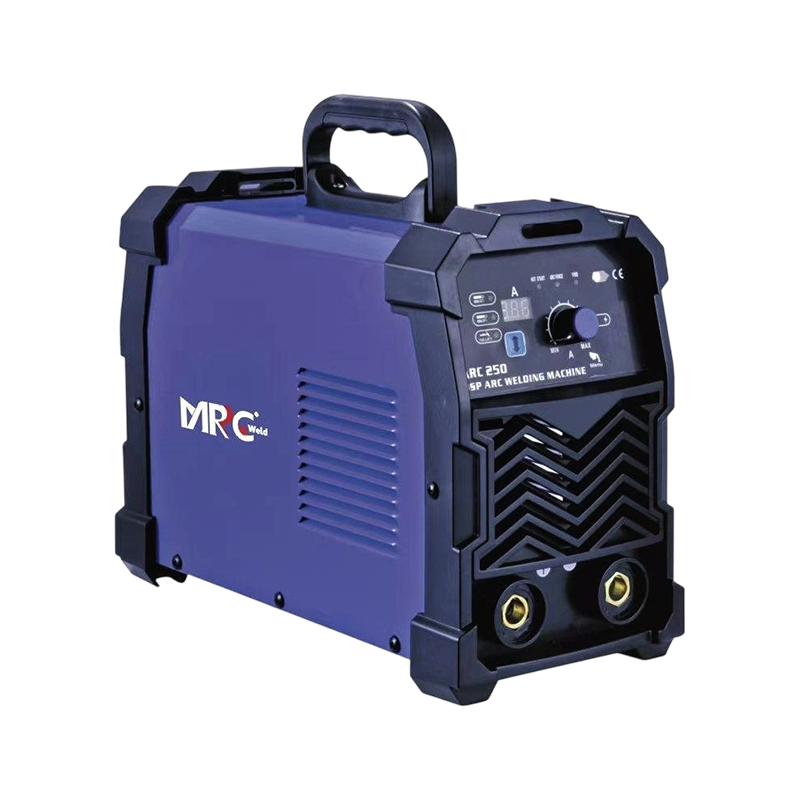 MMA-160/200/250 IGBT Inverter Stick Welding MachineA 160–250 A IGBT MMA inverter with anti-stick and forced arc start for structural and repair stick welding, built for portable on-site use.View Product →
MIG is where inverter control earns its price. Synergic mode links wire feed speed and voltage to one dial, so an operator switching from 0.8 mm mild steel to 1.0 mm stainless does not re-tune two variables by feel. Double pulse, which alternates between two current levels at roughly 0.5 Hz to 10 Hz, produces the stacked-dime bead aluminium body panels need. Spool size sets the duty class: 1 kg spools suit portable repair work with 0.6 mm to 0.8 mm wire, while 5 kg spools carry 0.8 mm to 1.0 mm wire through longer production runs.
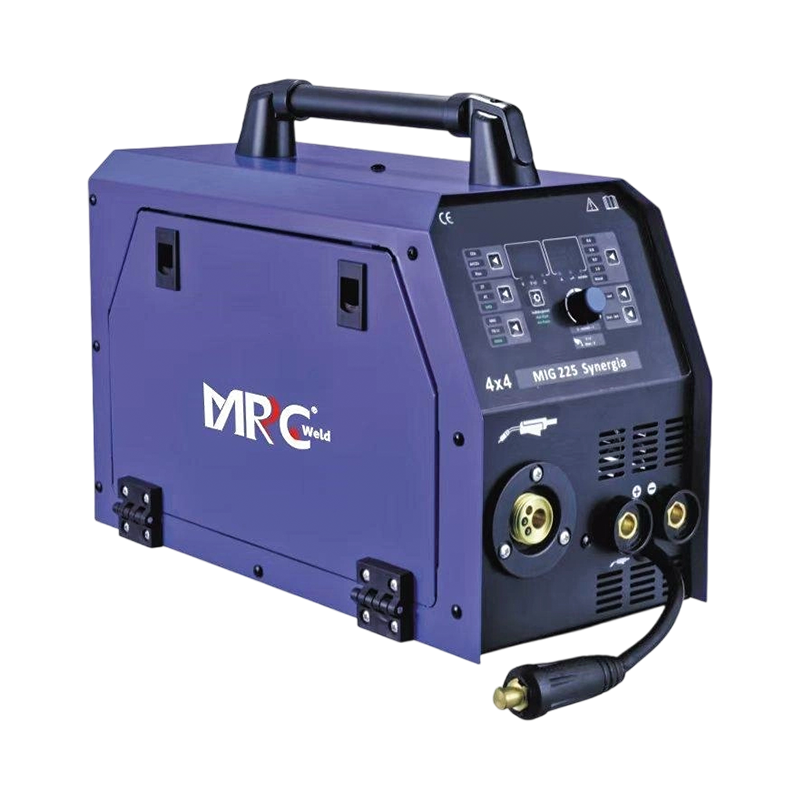 MIG-200SYN Synergic MIG Welder with Digital DisplayA synergic MIG system with LED/LCD parameter control and automatic wire feed, suited to thin-to-medium gauge steel and specialty metals where quick setup matters.View Product →
TIG covers the thin end of the range, and a 160 A to 200 A DC inverter with high-frequency ignition will weld 0.5 mm to 3 mm stainless and mild steel without scratch starting. The low-amperage stability of an inverter matters more here than headline output, since most TIG work happens between 40 A and 120 A. Plasma cutting follows the same logic in reverse: cut capacity tracks amperage, with 40 A units cutting around 14 mm, 60 A units around 22 mm and 100 A units around 35 mm, and portable 40 A models with an integrated compressor remove the need for a separate air line on repair sites.
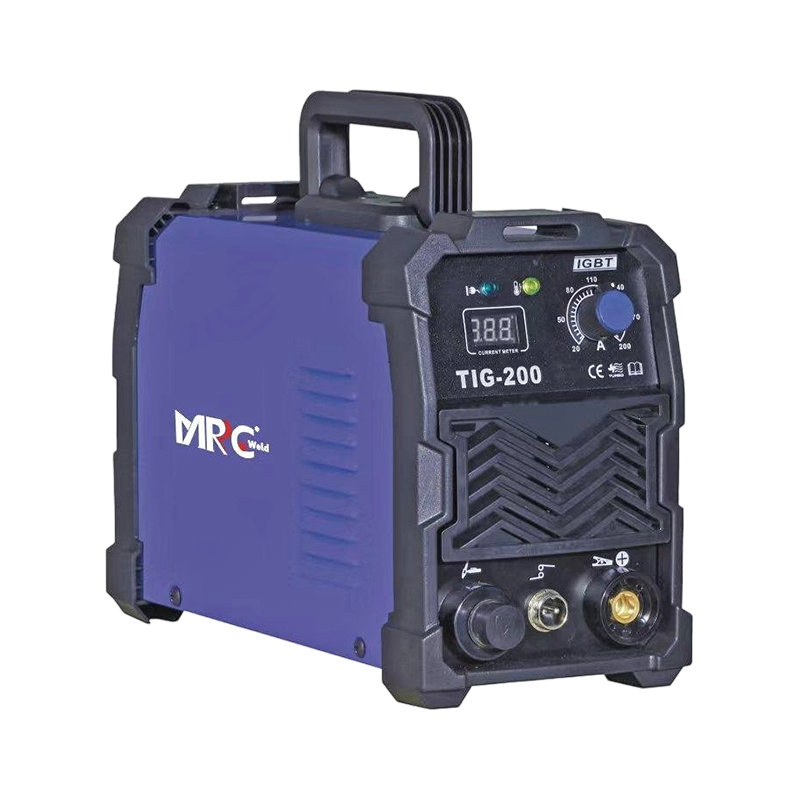 TIG-160/200 DC Inverter TIG Welding MachineA 160–200 A DC TIG inverter with high-frequency ignition and digital current control, offered as a complete kit for stainless, mild steel, and cast iron.View Product →
A 200 A single-phase inverter needs a generator rated at 8 kVA to 10 kVA, not a generator matched to the welder's 200 A output, because the load the generator sees is the input side of the power supply and not the arc. Undersized generators show up as arc instability, dropped arcs on start and, on some units, repeated IGBT protection trips.
Four site factors decide whether an inverter performs as specified:
Ask for four items before price becomes the conversation: a photograph of the data plate, the duty cycle test record at 40 °C, the IGBT module part number, and the consumable spare parts list. Each one closes a gap that a brochure cannot.
Buyers comparing process-specific options will find the practical detail in this guide to manual metal arc welding machines, which walks through electrode selection and arc behaviour on inverter power sources.
No, but it needs a correctly sized one. A 200 A single-phase inverter draws about 24 A at full output on 230 V, so a 32 A circuit with a 2.5 mm² cable up to 20 m is the practical minimum. Running the same machine on a 16 A household circuit will limit output long before the duty cycle does.
A 60% rating at 40 °C, measured over a 10-minute period under IEC 60974-1, is the working standard for industrial single-phase machines. That translates to roughly 155 A of continuous output, which covers 3.2 mm electrodes and light 4.0 mm work without thermal interruption.
Yes, provided the generator is rated at 8 kVA to 10 kVA for a 200 A single-phase machine. Size from the input kilowatts, not the welding amperage, and choose a generator with electronic voltage regulation so the arc stays stable as load changes.
In a correctly specified machine, the IGBT stack usually outlasts the torch and the drive system. Thermal cycling, not running hours, drives failure, so keeping the fan filter clean, respecting the 40 °C ambient rating and never blocking the intake ducts does more for service life than any single component choice.
1. How Does an MMA Welding Machine Work? Explanation of the basic operation and princi...
View MoreI. Introduction Welding is a fundamental process in countless industries, joining metals ...
View MoreI. Introduction: The key guardian of car energy In the complex system of the car, the Car...
View MoreWhat is car battery charger fully Car battery charger fully is a device specially used to...
View More
Copyright © TAIZHOU MIRACHER MACHINERY CO., LTD. All Rights Reserved Custom Industrial Welding Equipment Manufacturers


 English
 Português

 sale@miracher.com
 0086-15988994409