Content
A fabrication shop runs an eight-minute continuous bead on a 200 A MIG unit stamped 60 percent duty cycle, and the machine shuts down mid-pass. Nothing has failed. The thermal protector did exactly what the data plate promised. Duty cycle is the most misread number on a welding machine, and it has a standard answer that appears in trade exams worldwide: most welding machines have approximately 60 percent duty cycle at their rated output current.
That figure hides three conditions. It applies to one specific amperage, it is measured inside a fixed ten-minute window, and it assumes a defined ambient temperature. Once those three are clear, deciding whether a machine suits a job becomes arithmetic instead of guesswork.
Duty cycle is the share of a ten-minute window during which a welding machine can deliver its rated current continuously before it has to cool, expressed as a percentage.
Definition: duty cycle is the percentage of a ten-minute period during which a welding power source can weld continuously at its rated output current without exceeding its thermal limit.
The ten-minute window comes from the machine-safety standards used across export markets, IEC/EN 60974-1 in Europe and Asia and the equivalent NEMA EW-1 wording in North America. Ratings are declared at a reference ambient temperature of 40 degrees Celsius and, critically, at a stated current. A duty cycle without a current means nothing: 60 percent at 200 A and 60 percent at 120 A describe two different machines with two different price points.
| Declared duty cycle | Continuous welding per 10 minutes | Cooling time required |
| 20 percent | 2 minutes | 8 minutes |
| 40 percent | 4 minutes | 6 minutes |
| 60 percent | 6 minutes | 4 minutes |
| 100 percent | 10 minutes | none |
Across the air-cooled machines that dominate the global market, 60 percent is the rating that appears most often at nameplate current.
Why 60? It is a thermal and commercial compromise. A machine rated 60 percent at its nameplate needs a smaller transformer, a lighter heatsink and a cheaper fan than a unit rated 100 percent at the same current, which is how a 200 A inverter stays portable enough to carry onto a job site. The same figure is taught in welding curricula and licensing tests, which is why the fill-in-the-blank question on most exam papers expects 60.
Two buyers can read the same 60 percent figure and reach opposite conclusions if one is comparing a 160 A unit with a 300 A unit. The rating is only comparable when the current is attached to it.
Stick, MIG, TIG and plasma machines are usually all declared at 60 percent, but they reach that rating at very different currents, and operators rarely weld anywhere near a 60 percent arc-on time.
| Process | Typical rating at nameplate current | Typical operator arc-on time | Main limit on arc-on time |
| MMA / stick (120 to 200 A) | 60 percent | 10 to 20 percent | Electrode changes, slag chipping, repositioning |
| MIG / MAG (200 to 250 A) | 60 percent | 30 to 40 percent | Wire and gas checks, part handling |
| TIG (160 to 200 A) | 60 percent | 20 to 25 percent | Slow travel speed, filler addition, tungsten maintenance |
| Plasma cutting (40 to 100 A) | 60 percent | 20 to 30 percent | Short cut lengths, clamping and setup between cuts |
That gap matters. With a person holding the torch, a 60 percent machine is almost never the bottleneck, because the operator stops to change an electrode, clean slag, reposition a part or swap a spool. The rating starts to bind the moment the arc runs without interruption: automated cells, multi-station MIG setups, or a production line where the torch stays lit for minutes at a time.
Stick welding shows the pattern most clearly. An operator spends more time replacing electrodes and chipping slag than holding an arc, so manual metal arc machines rated 60 percent at 200 A seldom reach their thermal limit in day-to-day maintenance work, even though the data plate numbers look modest.
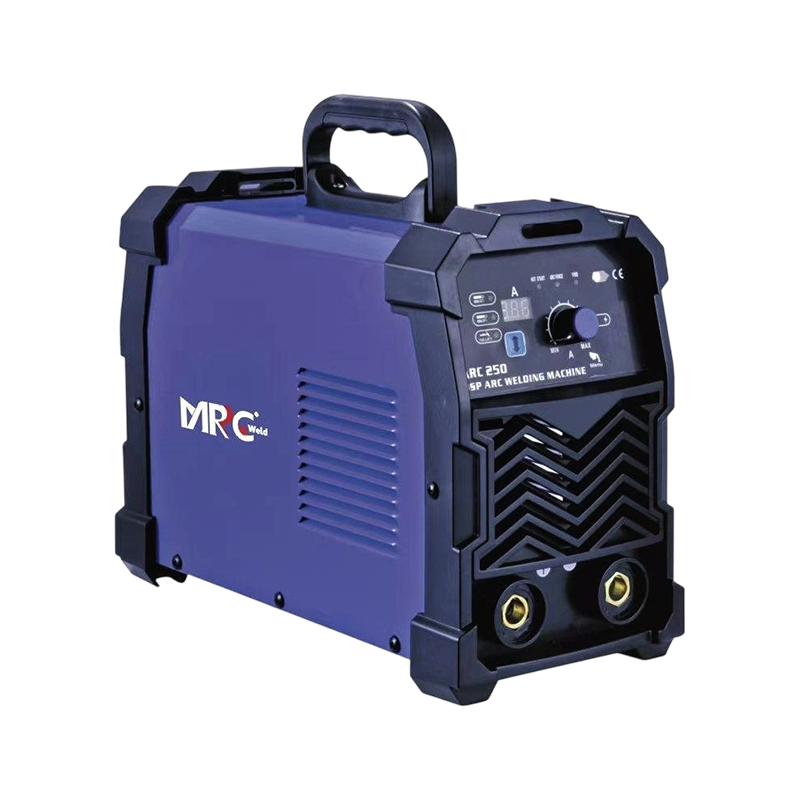 MMA-160/200/250 IGBTINNOVATIVE INVERTER WELDING MACHINE ENERGY-SAVING ANTI-STICK WELDING M● Instant arc ignition with 150% initial current boost for cold metal starts. ● Adopt IGBT inverter technology, stable output current, in line with international safet...View Product →
Duty cycle falls with the square of current, so the amperage a machine can hold continuously is always lower than its nameplate figure.
I2 = I1 x square root of (D1 / D2). At 200 A and 60 percent: 200 x square root of 0.6 = about 155 A available at 100 percent duty cycle.
Worked through, a 140 A machine rated 60 percent holds roughly 108 A continuously, a 250 A machine about 194 A, and a 300 A machine around 232 A. Those are the figures worth quoting to a customer who runs long seams, because they describe what the machine will do all day rather than what it can do for six minutes.
In the chart above, the solid bars are nameplate ratings at 60 percent and the lighter bars are the continuous output derived from the same rating. Bars are scaled to a 300 A maximum.
For manual welding, the operator is usually the limiting factor rather than the power source; the rating only starts to bite in continuous, high-current or hot-environment work.
Three conditions push a machine past its declared rating: welding above the rated current, working in ambient temperature above the 40 degrees Celsius reference, and restricted airflow. A 200 A unit running at 230 A in a hot foundry is outside every part of its rating, and the thermal cutout will say so within a few minutes.
Field rule: if a machine trips before its rated weld time has elapsed, the cause is almost always current above the rating, ambient heat above 40 degrees Celsius, or blocked airflow, not a defective unit.
The practical responses are simple. Keep 15 to 20 percent headroom below nameplate when long beads are expected, keep the fan grille clear, and never stack machines in a closed rack. A 200 A welder rated 60 percent is typically rated 100 percent somewhere between 150 A and 160 A, which covers most 3.2 mm and 4.0 mm electrode work and typical short-arc runs on 1.0 mm MIG wire.
Digital control helps here. Synergic and double-pulse units hold a stable current instead of surging, so the power source spends less time at peak draw, and MIG welding machines with automatic voltage tuning are easier to keep inside their thermal envelope on long production runs.
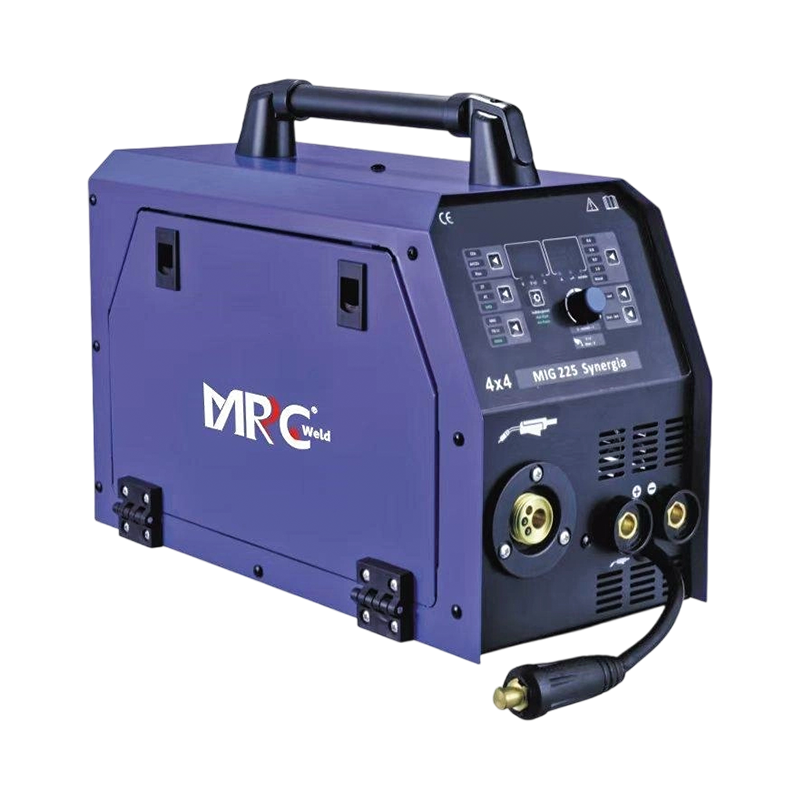 MIG-200SYN (LED/LCD) SYNERGIC MIG WELDER WITH AUTO-FEED LIGHTWEIGHT PORTABLE WELDING SYSTE● Digital display and knob, adjust parameters intuitive and convenient. ● The integrated SYNERGIC parameter optimization system ensures intuitive operation and streaml...View Product →
Compare machines at the same amperage and the same duty cycle, and always ask for the 100 percent duty current; a duty cycle figure on its own cannot be compared with anything.
When duty cycle rarely decides the purchase
When duty cycle decides the purchase
For shops that need TIG capability alongside stick work, a portable DC unit with automatic high-frequency ignition is the usual answer, and the duty cycle question comes down to the amperage the machine is rated at rather than the percentage printed next to it.
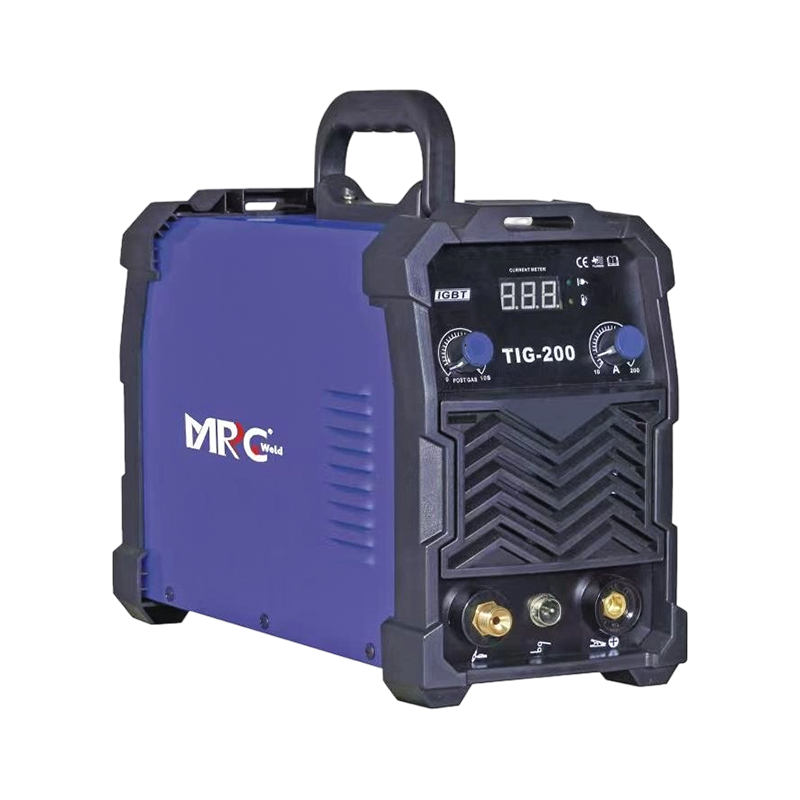 TIG/MMA-160/200 PORTABLE DC WELDING MACHINE WITH AN AUTOMATIC HIGH-FREQUENCY IGNITION● This multi-functional welding equipment features high-precision TIG welding and versatile MMA welding capabilities. ● It supports dual-mode welding, suitable for a c...View Product →
Most welding machines have approximately 60 percent duty cycle at their rated output current, measured over a ten-minute window at 40 degrees Celsius ambient. Compact units may declare 60 percent at a lower current, while heavy industrial machines can reach 100 percent at nameplate.
Six minutes out of every ten at the rated current, followed by four minutes of cooling. At lower current the same machine often welds without interruption, because a 60 percent rating at 200 A works out to 100 percent duty at roughly 155 A.
Not on its own. Duty cycle must be compared at the same amperage. A 250 A machine at 60 percent holds about 194 A continuously while a 200 A machine at 60 percent holds about 155 A, and that difference reflects a larger, heavier power source rather than better build quality.
Usually because one rating condition is not being met: the current is above the rated value, the ambient temperature is above 40 degrees Celsius, the fan or vents are blocked, or the input voltage is sagging. The thermal protector resets automatically, but repeated trips mean the machine is being operated outside its declared envelope.
60 percent is a declared rating, not a limit on what the machine can do. Match it to the current you weld at, the ambient you work in and the arc-on time your process produces, and the number stops being a mystery.
1. How Does an MMA Welding Machine Work? Explanation of the basic operation and princi...
View MoreI. Introduction Welding is a fundamental process in countless industries, joining metals ...
View MoreI. Introduction: The key guardian of car energy In the complex system of the car, the Car...
View MoreWhat is car battery charger fully Car battery charger fully is a device specially used to...
View More
Copyright © TAIZHOU MIRACHER MACHINERY CO., LTD. All Rights Reserved Custom Industrial Welding Equipment Manufacturers


 English
 Português

 sale@miracher.com
 0086-15988994409