Content
A 1.5 mm aluminium panel is where most buyers meet the problem. Short-arc MIG at 60 A spatters across the surface, warps the edges and adds a grinding step to every seam. Run the same joint on a pulse welding machine with peak current near 100 A and background current around 25 A, and the bead wets in cleanly with far less heat and spatter. That difference comes from a current waveform rather than a bigger transformer, which is why the specification sheet, not the price list, decides whether the machine earns its bench space.
A pulse welding machine is a power source that switches welding current between a high peak value and a low background value at a controlled frequency, so that one droplet of filler metal detaches during each peak.
In ordinary short-arc MIG, the arc transfers metal in a rhythm the welder can influence only through wire feed speed and voltage. Pulsing adds four parameters that shape the arc directly:
DefinitionPulse welding is a current waveform that alternates a droplet-detaching peak phase with a puddle-maintaining background phase, and the frequency sets how many droplets enter the weld each second.
Average current stays lower than a spray arc at the same deposition rate, so heat input into the part drops while penetration stays controlled. Modern machines hide most of that work inside synergic programs: the operator selects material, thickness and wire diameter, and the power source calculates peak, background and frequency on its own.
Double pulse earns its price on bead appearance, thin material and loose fit-up; single pulse covers everything else for less money.
Double pulse is not a second droplet mode. It modulates the whole pulse train with a low-frequency envelope, typically 0.5-5 Hz. During the high part of the envelope, current rises and the puddle spreads and penetrates. During the low part, current falls and the puddle cools and stiffens. The visible result is a stacked ripple that resembles a TIG bead, and the practical result is better control on parts that would otherwise burn through.
| Feature | Single pulse | Double pulse |
| Bead appearance | Uniform fine ripple | Stacked, TIG-like ripple |
| Heat control on 0.8-1.5 mm sheet | Good | Better, puddle stiffens between envelopes |
| Gap bridging on thin sheet | Limited | Wider gaps closed in one pass |
| Aluminium welding | Usable with the right setup | Preferred, especially 2-4 mm |
| Machine cost in the same current class | Baseline | Higher |
| Operator skill required | Moderate | More forgiving on thin material |
On 3 mm steel, both modes weld equally well and single pulse is the sensible purchase. On 1.5 mm aluminium or 1.0 mm galvanised sheet, the envelope gives the puddle time to freeze and turns a difficult job into a repeatable one. A 250 A class machine with a stored double pulse program covers most of that thin-sheet work:
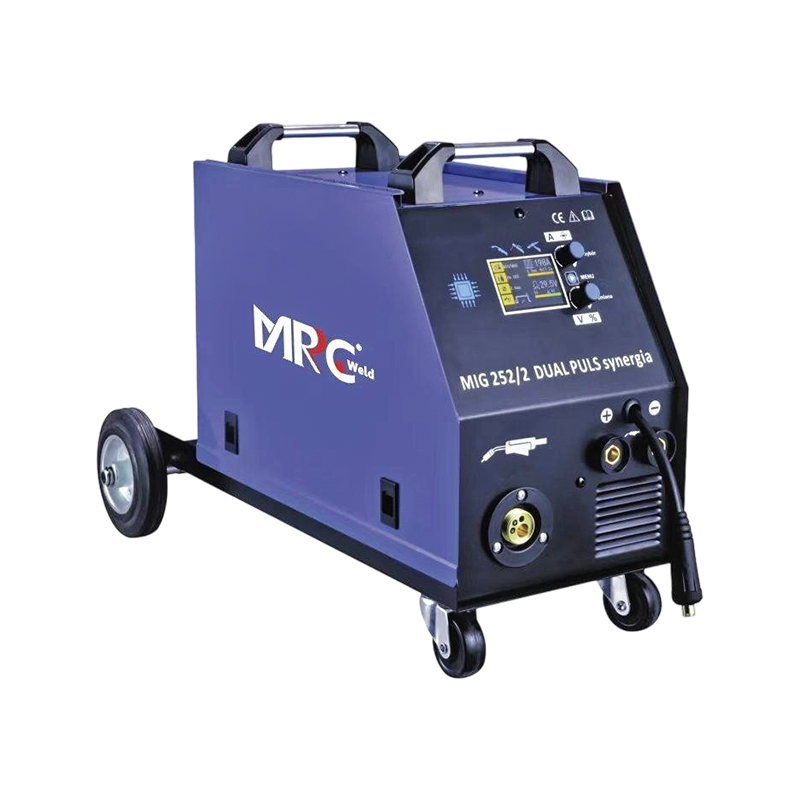 A INVERTER WELDING MACHINE MIG-250DP (LCD) DOUBLE PULSE WELDER● Microprocessor-controlled multi-process welder. ● Built-in synergy programmes. ● Adjustable gas outflow time. ● Adjustable pulse rate.View Product →
The wider setup picture, including torch angles, wire types and drive roll tension, is covered in this guide to MIG welding machines.
On TIG, pulsing controls the heat entering the part rather than metal transfer, because the arc stays on the same electrode and the pulse rate decides how quickly the puddle freezes.
DC pulse suits stainless and steel from about 0.5 mm upward. Frequencies of 0.5-5 Hz produce a visible ripple and a cooling window that helps on thin sheet and out-of-position work. Frequencies of 50-200 Hz narrow and stiffen the arc so it stays stable at low current, which helps on 0.5-1.0 mm edges. Above 200 Hz the arc tightens further, penetration increases and the heat-affected zone narrows. AC pulse applies the same logic to aluminium, where the cleaning half-cycle breaks up surface oxide before the weld forms.
For 1.5 mm stainless tube: peak current 70 A, base current 30 A, 2 Hz, 45 percent duty cycle. Raise the base current if the puddle stalls, lower it if the edges pull inward.
Pulse TIG units in the 160-200 A class with automatic high-frequency ignition cover most repair benches and light fabrication work, and they usually run MMA electrodes from the same case:
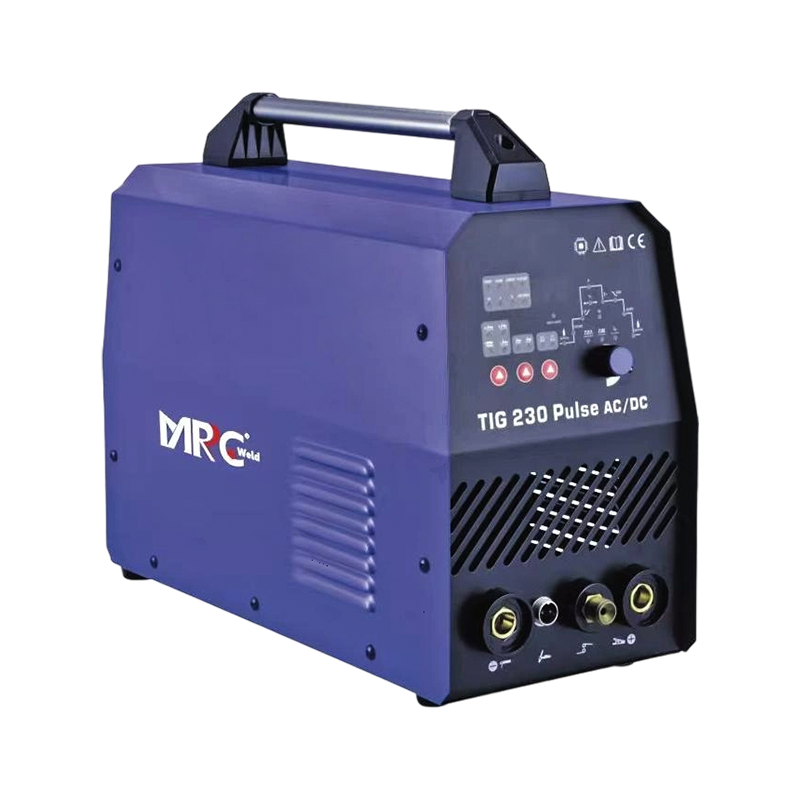 TIG-160P/200P IGBT INVERTER WELDING MACHINE PULSE DC/AC MULTI-FUNCTION KEY CONTROL● Supports multi-process welding. ● Incorporates advanced inverter technology to deliver premium output quality and optimized energy efficiency. ● AC/DC output capabil...View Product →
Start from the peak current band for the material and thickness, set wire feed speed to match, then use frequency and background current to fix the defect in front of you.
Adjust in that order. Wire feed speed sets the melting rate and has to be right before anything else moves. Arc length trim then shifts in 0.5 V steps until the arc sounds steady. Frequency settles bead appearance: too low gives a coarse, ropey bead, too high freezes the puddle before it wets the joint toe. Background current is the heat knob, raised for wetting on thick sections and lowered to control distortion and gaps on thin ones.
Magnetic pulse welding is not the same equipment as a pulsed MIG or TIG power source; it has been used industrially since 1967 to join metals with electromagnetic force and no filler metal at all.
In magnetic pulse welding, a coil discharges a short and intense current pulse that accelerates one workpiece into another at high velocity. The collision creates a solid-state bond without melting the bulk material, which makes dissimilar pairs such as copper to aluminium practical and leaves no filler, no fume and no conventional heat-affected zone. The geometry has to suit the process, however. Tubular and lap configurations work, the parts must be conductive enough to carry the induced current, tooling is built per part, and equipment cost sits well above arc welding.
Verify three things before ordering: duty cycle at the current you actually run, synergic programs for the wire diameter and gas you actually use, and the input voltage your workshop can actually supply. Everything else on the datasheet is secondary.
| Check | Why it matters | What to look for |
| Duty cycle at rated current | Sets how many minutes per ten-minute cycle the machine can weld | 60 percent at the current class you buy |
| Input voltage | A 220 V single-phase supply cannot feed a heavy three-phase machine | Match the model to the site supply before ordering |
| Synergic program library | Determines setup speed during mixed production | Programs for 0.8, 1.0 and 1.2 mm wire |
| Spool capacity | 1 kg spools suit site repair, 5 kg spools suit production runs | 5 kg feed for daily fabrication |
| Gasless FCAW mode | Outdoor crews cannot always carry gas cylinders | Required if work happens on site or in wind |
| Consumable supply | Liners, tips and drive rolls wear out first | Fast-shipping spares in the wire size you run |
Two failures show up after delivery more than any others. The first is a machine rated at 220 V single phase that trips a 16 A breaker under pulsed load, because peak current draws harder than the label suggests. The second is a program library that only covers 0.8 mm wire when the shop runs 1.2 mm, which turns every changeover into manual parameter hunting.
For multi-station fabrication, where one machine feeds several benches and several operators, a 350 A class unit with stored programs and collaborative control is the more practical purchase:
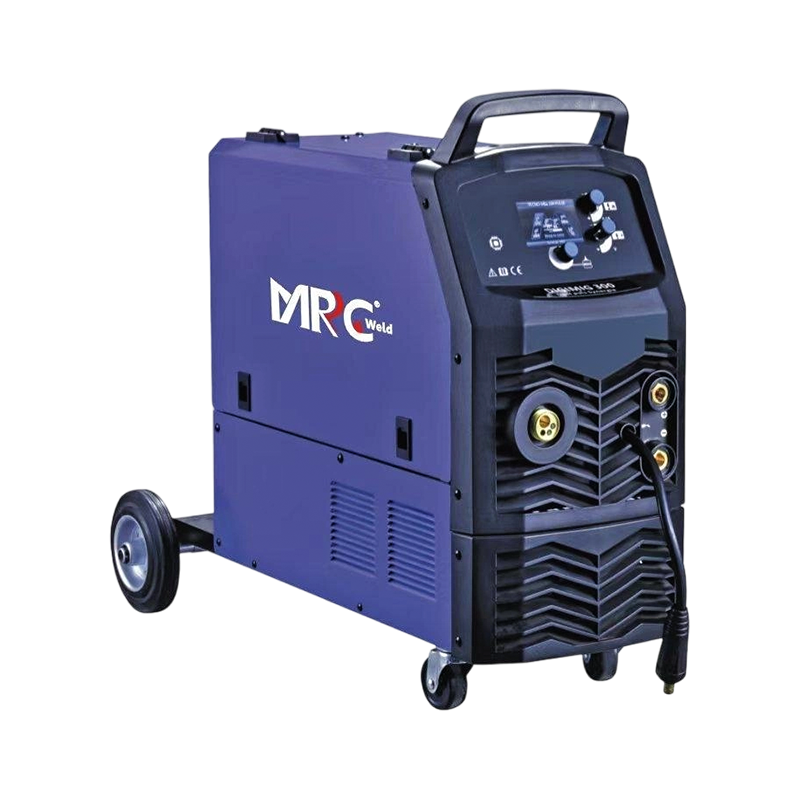 MIG-300DP/350DP MULTI-STATION WELDING MACHINE (LED/LCD) DUAL-VOLTAGE COLLABORATIVE CONTROLAdvanced IGBT inverter architecture paired with Dual-Pulse MIG Mode delivers precision welding for aluminum alloys and thin/medium-gauge materials.View Product →
Commission in this order, because wire feed speed invalidates every other setting if you change it last.
Material, thickness, wire diameter and shielding gas set the baseline. A program written for 1.0 mm wire runs hot and spattery on 0.8 mm.
Confirm output with a clamp meter within roughly 5 percent of the display before touching any other parameter.
Move in 0.5 V increments until the arc sound is steady and spatter stops flying past the nozzle.
Raise frequency when the bead looks coarse or ropey, lower it when the puddle freezes before it wets the joint edge.
Increase it when the toe will not wet on thick parts, decrease it when thin sheet distorts or gaps open up.
Finish with a 150 mm test coupon, cut it lengthwise and check penetration and fusion before the machine goes into production.
A standard MIG welder holds one output level per setting. A pulse welding machine alternates a high peak current with a low background current, so the arc detaches one droplet per pulse and average heat input stays low. The result is less spatter, better control on thin material and cleaner aluminium welds.
Pulse control fixes heat and spatter, not wire feeding. Aluminium wire is soft and buckles in a long torch lead, so a short lead, a push-pull torch or a spool gun is still needed. Machines in the 200-350 A range with a 5 kg spool and synergic aluminium programs handle the welding side once the feed path is solved.
On pulsed MIG, start with the synergic program for the material and thickness and treat 0.5-5 Hz as the double pulse envelope range. On pulse TIG, start at 2-5 Hz for thin sheet and out-of-position work, then move to 100-200 Hz when a stiff arc is needed at low current.
Not below 250 A. Most 120-250 A machines run on single-phase 220 V, provided the circuit and breaker are sized for peak draw. Machines in the 300-350 A class for continuous production usually specify 400 V three-phase, and some models accept dual voltage for both supplies.
1. How Does an MMA Welding Machine Work? Explanation of the basic operation and princi...
View MoreI. Introduction Welding is a fundamental process in countless industries, joining metals ...
View MoreI. Introduction: The key guardian of car energy In the complex system of the car, the Car...
View MoreWhat is car battery charger fully Car battery charger fully is a device specially used to...
View More
Copyright © TAIZHOU MIRACHER MACHINERY CO., LTD. All Rights Reserved Custom Industrial Welding Equipment Manufacturers



 English
  Português
 sale@miracher.com
 0086-15988994409