Content
A 1.5 mm 304 sheet welded at 110 A with no backing purge will show a grey, sugared root and a 3 to 4 mm bow across a 300 mm seam before the part has even cooled. That one result explains why a TIG welding machine for stainless steel is judged on how steadily it holds a 20 A arc and how cleanly it restarts, not on the size of the number printed on the front panel.
Stainless is not hard to melt. It is hard to keep clean and flat. Austenitic grades such as 304 conduct heat at roughly 16 W/mK, against about 50 W/mK for mild steel, so arc energy concentrates next to the weld instead of spreading into the plate. Machine choice, gas coverage and travel speed all have to work with that behaviour rather than against it.
Stainless steel is welded with TIG on direct current electrode negative (DCEN) under argon, and the two things that ruin a joint are heat concentration and chromium carbide precipitation between 450 °C and 850 °C. Both are process problems, not operator attitude problems.
That independence is why TIG remains the reference process for hygienic tube, thin sheet and cosmetic face welds. It is also why the process exposes weak equipment: a unit with a coarse 30 A minimum, a scratch start that contaminates the tungsten, or an air-cooled torch that overheats at 120 A will generate rejects that no amount of operator skill can recover.
Austenitic stainless needs roughly 30 to 40 A per millimetre of thickness on DC TIG, so 1.6 mm sheet runs at 55 to 80 A and 6 mm plate at 165 to 210 A across a bevelled, multi-pass joint. Those figures assume argon shielding, a 2% thoriated or ceriated electrode and a controlled travel speed.
Filler diameter follows the same logic: 1.6 mm rod for sheet up to 2 mm, 2.4 mm rod for 3 to 6 mm sections and 3.2 mm for heavy plate and thick-wall tube. An oversized rod pulls heat out of the pool, the operator compensates with more current, and that is how 1.5 mm sheet ends up dished around the seam.
| Base metal | Filler (AWS A5.9) | Shielding gas | Practical note |
| 304 / 304L | ER308L | Argon | Standard sheet and sanitary work |
| 316 / 316L | ER316L | Argon | Molybdenum grade for chloride service |
| 321 | ER347 | Argon | Titanium-stabilised, no solution treatment needed |
| 2205 duplex | ER2209 | Argon only | No hydrogen addition, ferrite balance 35 to 60% |
| Carbon steel to 304 | ER309L | Argon | Dissimilar joints and buffer layers |
| 430 ferritic | ER430 | Argon | Low heat input, avoid hydrogen mixes |
Stainless steel is welded on DCEN with a tungsten ground to a taper 2 to 2.5 times its diameter; alternating current is reserved for aluminium and magnesium, where it is needed to break the refractory oxide film.
Tungsten diameter tracks current, not material: 1.6 mm covers 60 to 100 A, 2.4 mm covers 100 to 200 A and 3.2 mm covers 200 to 300 A. Grind on a wheel reserved for tungsten, with the grinding marks running along the axis of the taper, so the arc roots at the tip instead of wandering.
On 0.5 to 3 mm stainless, the features that decide quality are high-frequency arc start, a stable minimum current near 10 A and repeatable pulse control; maximum output current is secondary.
High-frequency starting strikes the arc without touching the work, so the tungsten stays sharp and the first 10 mm of weld stay clean. A machine with a 30 A floor cannot weld 0.8 mm sheet at all, because the required 40 to 45 A sits less than one step above it and the arc extinguishes on the down-slope. The IGBT inverter TIG160 and TIG200 models pair high-frequency ignition with digital current display, which makes a repeatable 45 A setting achievable rather than approximate.
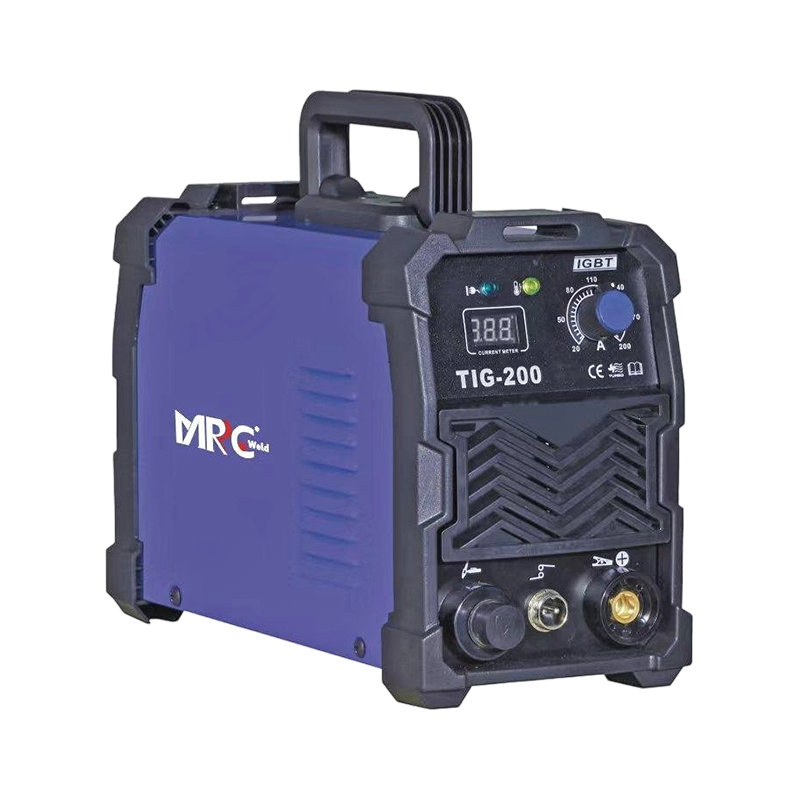 TIG-160 and TIG-200 IGBT Inverter WeldersComplete TIG kit with high-frequency ignition and digital current display for repeatable low-current settings on thin stainless and DC welding.View Product →
Pulse alternates a peak current with a lower background current: 100 A peak against 40 A background at 2 Hz cuts average heat input by roughly 30% and lets the pool freeze slightly between pulses. On 0.8 to 1.5 mm stainless that is the difference between a flat seam and a 5 mm bow. Pulse-capable units such as the TIG160P and TIG200P add AC output as well, which covers aluminium repair work from the same power source.
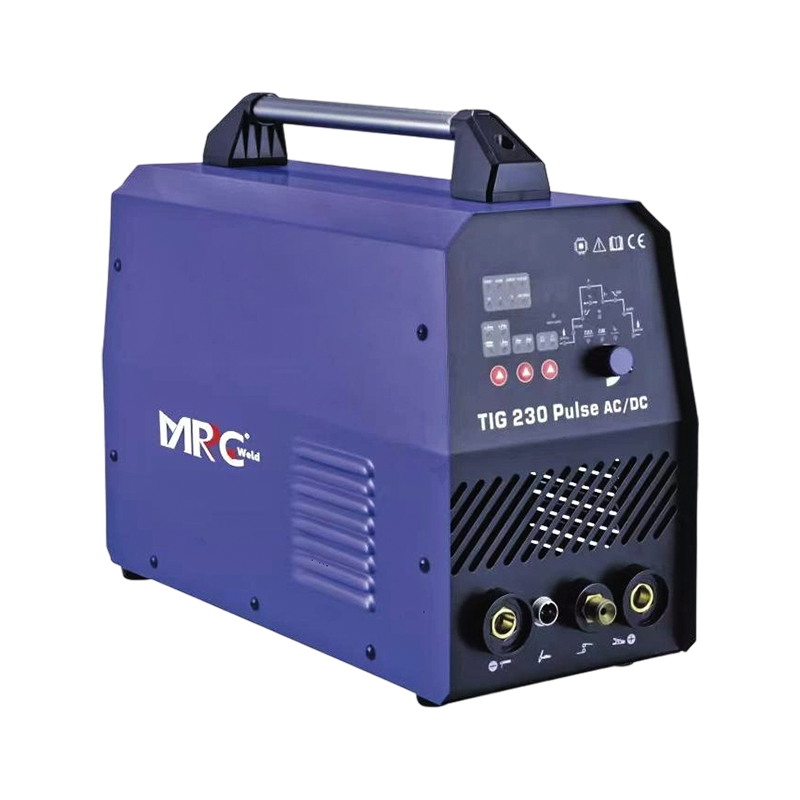 TIG-160P and TIG-200P Pulse AC/DC WeldersPulse-capable TIG/Stick units with AC/DC output and key control, adding aluminium repair capability while supporting stainless, carbon steel and cast iron work.View Product →
Duty cycle is rated at 40 °C ambient: a 200 A machine at 60% duty delivers 6 minutes of full output in every 10, with the remainder spent on fan cooling. That is enough for 3 mm sheet but marginal for continuous 6 mm plate. From 6 mm upward, MMA on the same box with E308L-16 electrodes deposits faster than hand-fed TIG, which is why TIG/MMA dual machines hold their place in repair shops. MIG extends that logic further on thick stainless, and the process comparison in this guide to MIG welding machines is worth reading before a second process is specified.
Hold heat input under roughly 1.0 kJ/mm on 3 mm 304L, keep interpass temperature at or below 150 °C and purge the root below 100 ppm oxygen to prevent sugaring. Those three numbers control distortion, corrosion resistance and rework rate on the same weld.
For the purge, water-soluble dams or dedicated inflatable plugs hold argon in the bore: flush at 10 to 12 L/min for two to three pipe volumes, then reduce to about 5 L/min and confirm the outlet reading with an oxygen meter before striking an arc. Post-weld cleaning to ASTM A380, by pickling or citric passivation, restores the chromium oxide layer that gives stainless its corrosion resistance, and brushes used on stainless should never touch carbon steel.
Specify the 160 A or 200 A class machine in single-phase 220 V for site work, and confirm that torch, foot pedal, gas regulator and consumable kit ship in the same carton, because those five items decide whether the machine is usable on the day it lands.
Buyers comparing configurations across the 160 A to 200 A range can review the full TIG and MMA lineup in the welding equipment catalogue before fixing voltage and accessory sets. For shops that also repair stainless fixtures and truck bodies, a portable DC unit with torch-switch control removes the need for a separate power source at the job site.
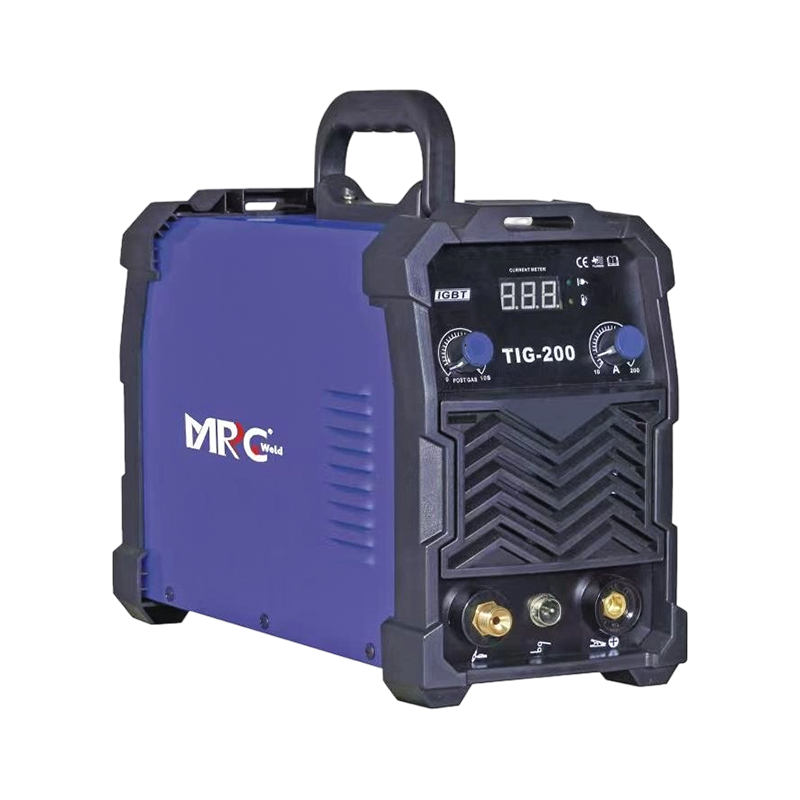 TIG/MMA-160 and TIG/MMA-200 Dual-Mode WeldersPortable DC TIG/MMA dual-mode units with high-frequency ignition and digital display, letting one power source cover stainless repair and Stick welding tasks.View Product →
Yes. Three millimetre 304 needs 100 to 130 A, so a 160 A unit operates at roughly 65 to 80% of its rating. The real constraint is duty cycle and torch cooling, not arc power: with a 60% duty rating and an air-cooled 9 series torch, plan on short passes and allow the torch to cool between them.
No. Alternating current exists to break the aluminium oxide layer, and stainless is welded on DCEN in every common shop application. Money is better spent on pulse control, a 10 A minimum current and high-frequency starting than on AC capability.
Run 70 to 95 A on a 1.6 mm ceriated or thoriated electrode, argon at 8 L/min through a standard collet body (6 L/min with a gas lens), and 1.6 mm ER308L filler. That combination holds a flat seam at 0.6 to 0.8 kJ/mm heat input with no bevel preparation.
Tape one end, feed argon at 10 to 12 L/min for two to three pipe volumes, then drop to about 5 L/min and confirm the reading at the open end is below 100 ppm oxygen with a meter. Only then strike the arc, and keep the flow running until the root has cooled below 200 °C.
1. How Does an MMA Welding Machine Work? Explanation of the basic operation and princi...
View MoreI. Introduction Welding is a fundamental process in countless industries, joining metals ...
View MoreI. Introduction: The key guardian of car energy In the complex system of the car, the Car...
View MoreWhat is car battery charger fully Car battery charger fully is a device specially used to...
View More
Copyright © TAIZHOU MIRACHER MACHINERY CO., LTD. All Rights Reserved Custom Industrial Welding Equipment Manufacturers


 English
 Português

 sale@miracher.com
 0086-15988994409