Content
This guide is written for the buyer who has already settled on inverter technology and now has to pick a current class, a duty cycle, an input voltage and a control level. It covers what happens inside the box, how MMA, MIG/MAG and TIG load an inverter differently, how to read a duty-cycle figure at 40 C, and the five checks that belong before a container is booked.
An inverter welder replaces one iron core built for 50 Hz with four electronic stages and a ferrite core the size of a fist, and that single substitution is responsible for the entire weight reduction.
A 50 Hz transformer needs a core cross-section roughly 800 times larger than a 40 kHz transformer handling the same power, because core area scales inversely with frequency. The rectifier front end, the IGBT bridge, the ferrite transformer and the output rectifier together weigh under 1.5 kg at the 200 A level; the copper and iron they replace weigh more than 20 kg.
Efficiency moves with the topology. A conventional stick welder converts 55% to 65% of its input into arc power, an IGBT inverter reaches 85% to 90%, and the difference leaves the machine as case heat instead of line loss. With a power factor correction stage fitted, a portable inverter holds a power factor near 0.95, so a 230 V circuit that trips on a 9 kVA transformer welder will carry a 6.5 kVA inverter on the same breaker.
The electronic stage is also what makes the control functions possible. A digital MMA inverter such as the MMA160/200/250 IGBT series regulates open-circuit voltage, releases a stuck electrode automatically and holds current within a few percent as arc length changes; a transformer machine can approximate that only with a moving shunt.
The three common processes load an inverter in different ways: MMA needs 60 V to 80 V of open-circuit voltage and a drooping characteristic, MIG/MAG needs flat constant-voltage output between 14 V and 30 V, and TIG needs constant current with a high-frequency start.
Current class follows electrode and wire size rather than headline amperage. A 2.5 mm E6013 electrode runs at 70 A to 110 A, a 3.2 mm at 100 A to 140 A, a 4.0 mm at 140 A to 190 A and a 5.0 mm at 190 A to 240 A. A 160 A inverter covers 3.2 mm comfortably; 4.0 mm at production pace belongs in the 200 A class.
| Process | Output characteristic | Models in the range | Typical work |
| MMA | Drooping curve, 60 to 80 V OCV | MMA120/160/200 mini, MMA160/200/250 IGBT | Site repair, 2.5 to 4.0 mm electrodes |
| MIG/MAG | Flat constant voltage, 14 to 30 V | MIG120 up to MIG350SYN, 1 kg and 5 kg spools | Body panels and sheet, 0.8 to 1.2 mm wire |
| TIG DC | Constant current, 10 to 16 V arc | TIG160/200, TIG160P/200P | 0.5 to 6 mm stainless and carbon steel |
| Plasma cutting | Constant current with pilot arc | CUT40, CUT60, CUT100 | 14 mm, 22 mm and 35 mm severance |
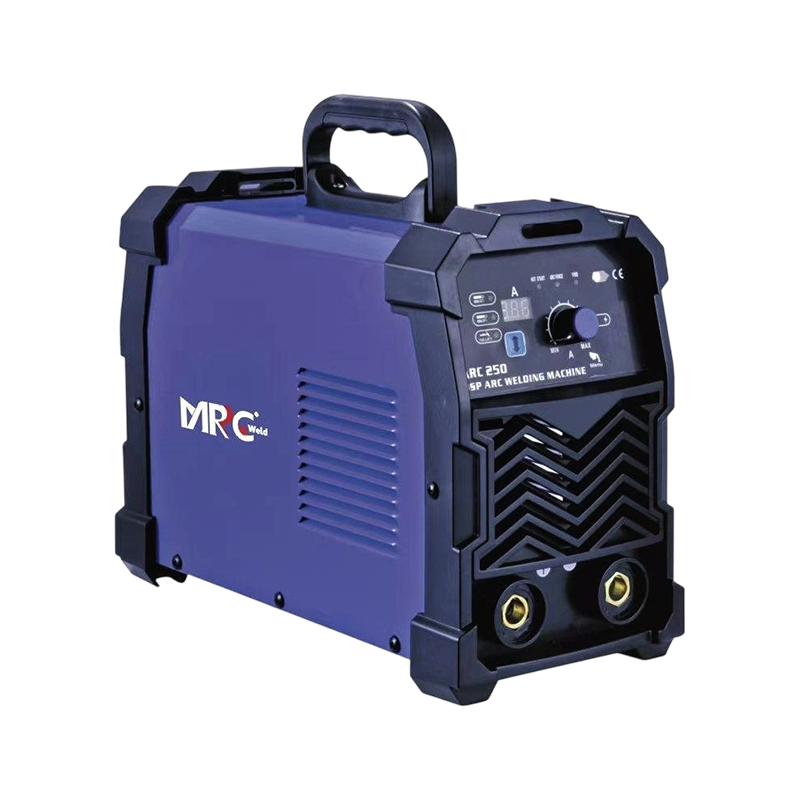 MMA-160/200/250 IGBT Inverter Stick Welding MachinePortable IGBT MMA welder with anti-stick arc start, stable output and multiple protection, covering light fabrication and mobile repair work.View Product →
The MIRACHER range, built by Taizhou Mirach Machinery Co., Ltd. in Zhejiang, follows that logic: 1 kg spool MIG units from MIG120 to MIG160SYN for sheet and body work, 5 kg spool units from MIG200SYN to MIG350SYN for semi-industrial duty, and 5 kg spool models with synergic or double-pulse control for aluminium and thin-gauge production. Gasless FCAW mode on the MIG120 and MIG160 models removes the cylinder from outdoor work entirely.
Duty cycle on an inverter is rated at 40 C ambient to IEC 60974-1, and a machine sold as 200 A at 60% delivers about 155 A continuously, not 200 A.
The rating is a percentage of a ten-minute period: 60% means six minutes of arc followed by four minutes of cooling, repeated. Heating rises with the square of current, so the continuous current that produces the same heat is the rated current multiplied by the square root of the duty cycle. At 200 A and 60%, that is 200 x 0.775, or 155 A.
Watch the ambient figure as closely as the percentage. A 60% rating quoted at 25 C is not the same machine as 60% at 40 C; a 15 C gap in ambient is worth roughly half the thermal margin on a small frame. Export buyers should ask for the 40 C figure in writing, because that is the number a welding inspector in Rotterdam or Jebel Ali will test against.
A 200 A single-phase inverter draws about 6.5 kVA at full output, which means a 32 A supply at 230 V or a generator rated at 10 kVA and above.
Dual-voltage models switching between 110 V and 220 V single phase cover markets where both supplies exist, but the 110 V input caps output near 90 A to 120 A because the same socket carries roughly half the power. Above 250 A of MIG output, three-phase 380/400 V is the practical input, and it is why the 5 kg spool MIG300DP and MIG350SYN units are specified for workshop rather than site use.
Generator sizing follows one rule: the set should be rated at 1.5 to 2 times the welder input kVA, and total harmonic distortion should stay below 10%. A 2 kW suitcase generator will start a 120 A inverter and trip on a 200 A unit under load. Cable length matters as well; 2.5 mm² leads hold voltage drop inside 4% up to about 20 m, 4 mm² up to about 35 m, and anything longer forces the current setting up to compensate.
A synergic MIG inverter stores a voltage-to-wire-feed-speed curve for each wire diameter and shielding gas, so one dial sets both parameters and holds the arc within about 1 V of the correct condition.
Without synergic control the operator sets wire feed speed and voltage independently, and a 0.8 mm wire running from 40 A to 160 A needs a different pairing at every step. The synergic curve removes that judgement, which is why a 200 A synergic unit can be handed to a fitter who welds twice a week and still produce repeatable bead profiles.
Double pulse alternates two current levels at 1 Hz to 5 Hz, producing a TIG-like ripple that keeps the weld pool cool between pulses. On 2 mm to 6 mm aluminium it reduces burn-through and improves gap bridging; on thin steel it stabilises arc starts where a single-pulse machine punches holes. Both functions cost money and both are wasted on 3 mm mild steel run at 130 A.
For a deeper look at wire selection and transfer modes on these machines, the site's guide to MIG welding machine setup and technique covers the practical settings.
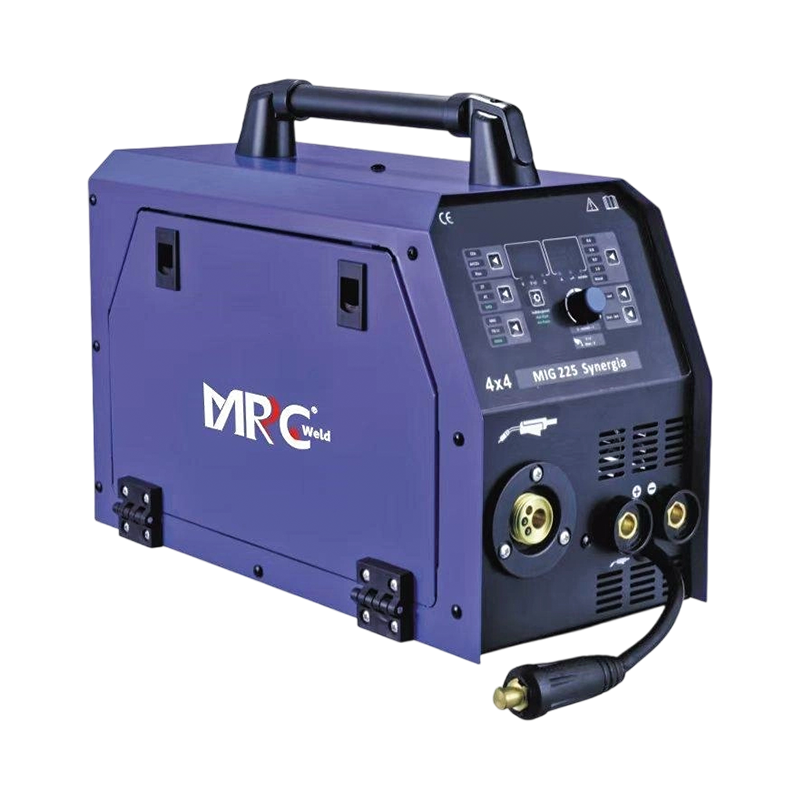 MIG-200SYN Synergic MIG Welder with 5 kg SpoolMicroprocessor-controlled synergic MIG unit for thin to medium-gauge steel and specialty metals, offering LED/LCD feedback, low spatter and 5 kg wire capacity.View Product →
A 160 A to 200 A DC TIG inverter covers 0.5 mm to 6 mm stainless and carbon steel, and strikes the arc with a 3 kV to 5 kV high-frequency pulse instead of scratch starting.
High-frequency ignition matters at low current. Scratch starting a 1.6 mm tungsten at 25 A contaminates the tip with base metal on roughly one start in three; an HF start removes contact entirely and keeps the electrode clean. Pulse output, typically adjustable from 0.5 Hz to 300 Hz, cuts heat input on 1 mm sheet enough to weld an edge without distortion.
The limit is material. A DC TIG unit will not break the aluminium oxide layer, so aluminium above 3 mm needs either AC TIG output or a double-pulse MIG inverter from the same range. TIG/MMA dual-mode models such as the TIG160P and TIG200P let one box cover both the precision work and the site repair, which is often the deciding factor for a service contractor buying two machines for a van.
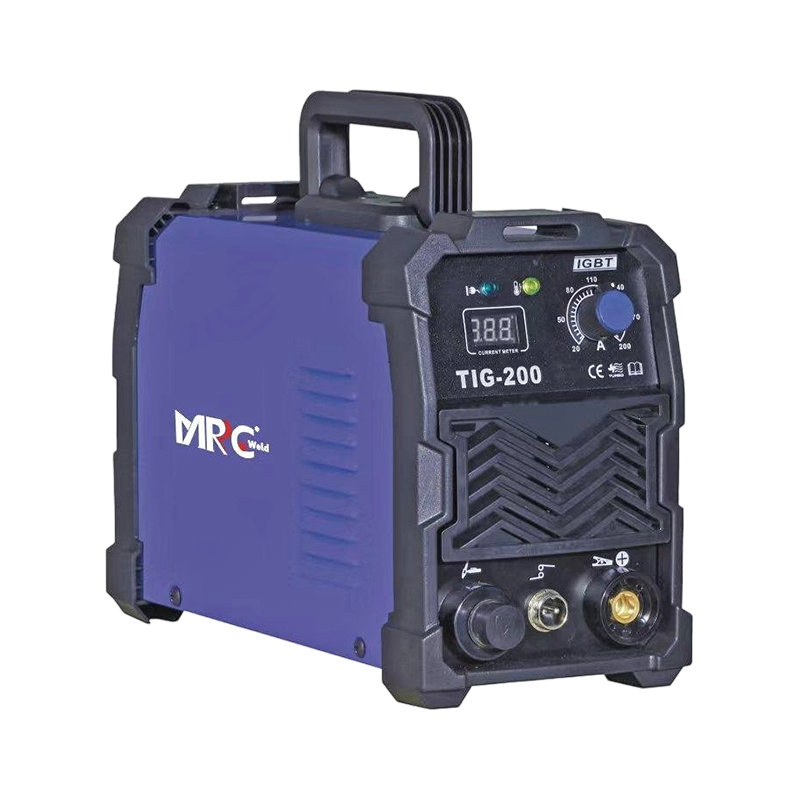 TIG-160/200 DC TIG Welding MachineCompact IGBT DC TIG welder with high-frequency arc start, digital current control and protective functions for stainless, mild steel and cast-iron work.View Product →
Five items decide whether a container of inverters performs in the destination market: duty cycle at 40 C, input voltage and plug configuration, consumable spares, certification to IEC 60974-1, and a weld sample on the buyer's own material.
MIRACHER supports voltage adaptation and function module changes for different market standards, so steps two and four are handled at specification stage rather than after shipment. The full inverter welding machine range covers MMA, MIG, TIG, plasma cutting and battery charging equipment from one factory floor in Taizhou.
Four questions come up in almost every inverter quotation, and each one has a numeric answer.
A 160 A inverter rated 60% at 160 A delivers 124 A continuously at 40 C, which sits at the top of the 3.2 mm range of 100 A to 140 A. For non-stop work at 140 A, specify the 200 A class, which holds 155 A at 100% duty.
Yes, when the generator is rated at 1.5 to 2 times the welder input kVA. A 200 A inverter drawing 6.5 kVA needs a 10 kVA set with total harmonic distortion below 10%, and the welder should be started on the generator with the current dial at minimum.
Most portable units are rated IP23S, which stops fingers and light rain but not conductive dust or condensation. Dust bridging the heat sink and control board is the dominant failure mode, so blow the case out with dry air every 100 hours of arc time and store the machine above 5 C.
Maximum current is identical; sustained output is not. Compare the 40 C duty cycle and the open-circuit voltage, because a transformer at 80 V OCV still runs cellulosic E6010 rods more predictably than an inverter limited to 60 V.
1. How Does an MMA Welding Machine Work? Explanation of the basic operation and princi...
View MoreI. Introduction Welding is a fundamental process in countless industries, joining metals ...
View MoreI. Introduction: The key guardian of car energy In the complex system of the car, the Car...
View MoreWhat is car battery charger fully Car battery charger fully is a device specially used to...
View More
Copyright © TAIZHOU MIRACHER MACHINERY CO., LTD. All Rights Reserved Custom Industrial Welding Equipment Manufacturers



 English
 Português

 sale@miracher.com
 0086-15988994409